Stop Bringing It Back to You
Welcome to another Toolkit Tuesday! Every week, our goal is to give you a practical leadership tool to put in your toolkit.
So There I Was . . .
So there I was, sitting in a session with a client team, about ten people in the room, including the senior leader. This guy was sharp. You could tell right away he understood the business, the numbers, the strategy. He had a lot to offer.
But as the conversation got going, something else started to stand out. Every time someone on the team shared an idea or perspective, he would bring it back to himself. “I did it this way before,” or, “That reminds me of when I used to…” It wasn’t aggressive. It was just constant.
After about ten minutes, you could see it on the faces around the room. The energy started to drop. People stopped leaning in. It was like the will to engage slowly drained out of them.
That moment stuck with me. Not because the leader was trying to do anything wrong, but because of how easy it is to fall into that pattern without realizing it.
The Challenge
Most of us don’t think we do this.
We think we’re adding value. We think we’re relating. We think we’re helping move the conversation forward.
But when the conversation keeps coming back to us, even with good intentions, it communicates something else. It tells the other person that we are more focused on being heard than understanding.
Over time, that erodes trust. People start to hold back. They share less. And without realizing it, we limit our own influence.
The Tool: Boomerang Effect
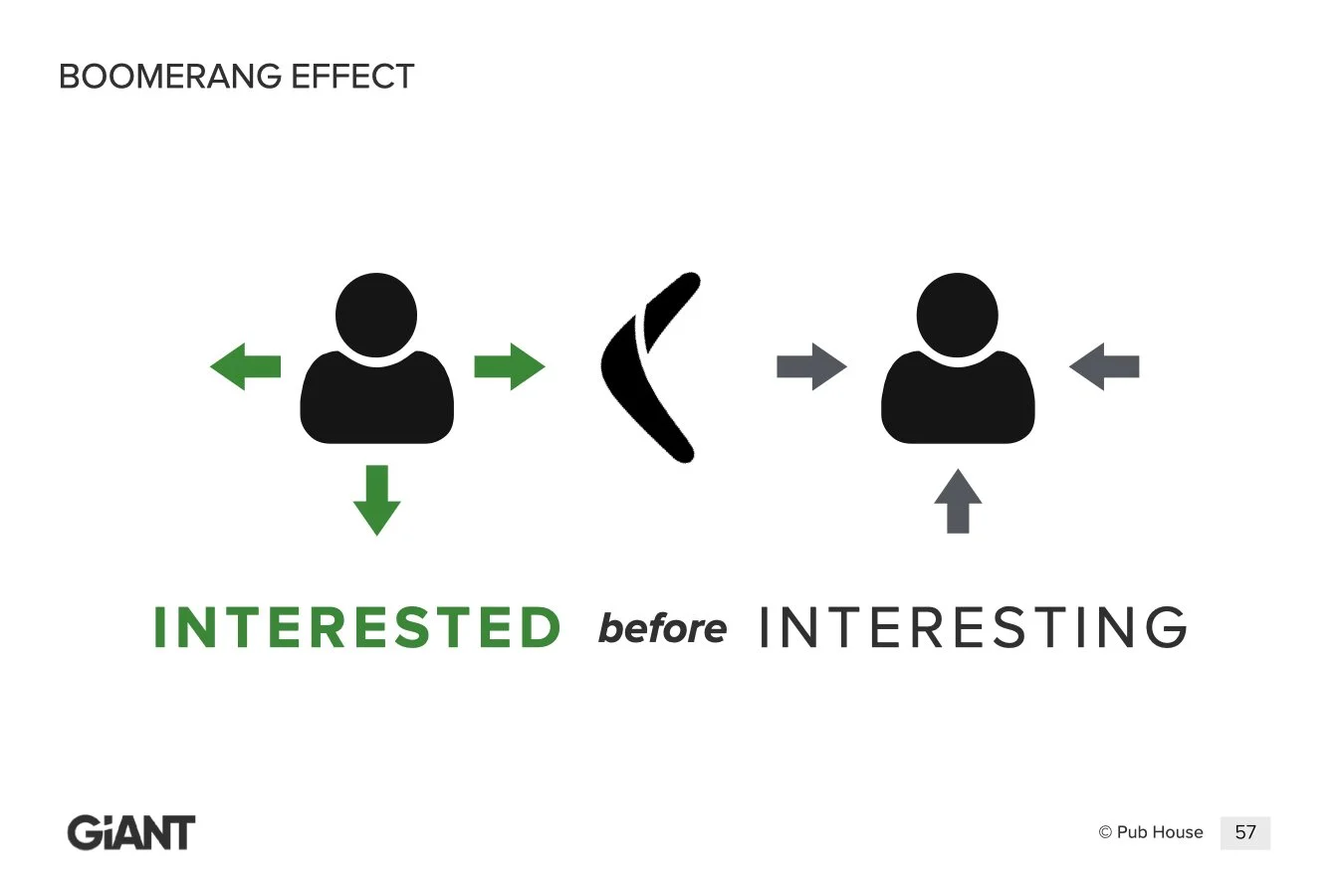
The Boomerang Effect is the tendency to bring the conversation back to yourself. You throw it out, listen for a moment, then bring it right back to you.
To counter this, shift your focus from being interesting to being interested:
Ask simple questions like “Where are you from?” or “What got you into this?”
Stay with their answer longer than feels natural
Resist the urge to immediately relate it back to your own story
Look for common ground without taking over the conversation
The goal is not to never share. It’s to earn the right to share by first showing genuine interest.
Why This Matters Now
The reality is, all of us have to follow someone at work and in life.
Competence matters. We want to know the person leading us knows what they’re doing. But competence alone only gets you so far.
What actually builds trust is the combination of competence and connection.
When people feel like you’re genuinely interested in them, not just talking at them, something shifts. They engage more. They contribute more. They’re more willing to go the extra mile because they feel like they matter, not just the work.
That kind of trust doesn’t come from saying more. It comes from paying attention more. And that starts with being interested before trying to be interesting.
The Result
Later on, I had a chance to sit down with that leader one on one.
As we worked through the Know Yourself to Lead Yourself tool, he was able to see it clearly. He had a tendency to monopolize the conversation. Not on purpose, just by habit.
That awareness gave him a choice.
If he continued the same pattern, nothing obvious would break. The team would still show up. Work would still get done. But over time, people would hold back. Engagement would stay low. And his influence would quietly plateau.
But if he chose a different approach, if he stayed interested just a little longer, asked one more question, resisted bringing it back to himself, things would shift.
People would start to lean in again. They would share more. Trust would build. And his influence would grow in a way that competence alone could never create.
Take Action
First, in your next three conversations today, challenge yourself to ask at least two follow-up questions before sharing anything about yourself. Stay with the other person longer than feels comfortable.
Second, if you want to grow your influence and communication as a leader, let’s talk. You can schedule a time to talk with us.
Closing the Loop
That moment in the room stuck with me.
Not because the leader lacked anything. He was capable, experienced, and respected. But in that stretch of conversation, something small was getting in the way.
Once he saw it, the shift was simple. Stay with people a little longer. Ask one more question. Let the conversation be about them before bringing it back.
It didn’t require new skills. Just a different choice.
And that’s usually where influence either grows or stalls.