Are You Thinking Out Loud or Giving Direction?
Welcome to another Toolkit Tuesday! Every week, our goal is to give you a practical leadership tool to put in your toolkit.
So There I Was . . .
Recently I was catching up with a friend who does design work for a large tech company. I asked how work was going and he laughed and said, “Honestly, it’s been rough.” He told me he had a nickname for his boss… and it wasn’t exactly a compliment.
I asked what he meant and let him talk.
He said every meeting feels the same. His boss jumps on Zoom and just starts talking. Idea after idea, direction after direction. By the end of it, my friend walks away thinking he has clear instructions.
So he goes to work. And not just a quick draft. He’s putting in 10 to 14 hours building detailed designs based on what he heard. Then he sends it over.
And almost every time the response is, “No, that’s not what I want. I was just thinking out loud.” And it keeps happening.
The Challenge
What makes this even more frustrating is he’s not just guessing. He’s trying to clarify.
He’s asked directly, “Is this the direction you want me to go?” And his boss will say, “Yeah, I think so,” or even just “Yes.”
But it doesn’t hold.
Over time, that starts to break something. Not effort, not work ethic, but trust.
He told me he doesn’t trust anything his boss says anymore. When he hears “this is the final version,” he doesn’t believe it. So now every project carries a layer of second guessing.
And it’s not just one leader. It’s part of the culture. A lot of talking, a lot of ideas, but no clear signal on what’s real and what’s still forming. That’s where the real problem shows up. Not in bad intent, but in unclear communication.
The Tool: Provisional Plan Promise
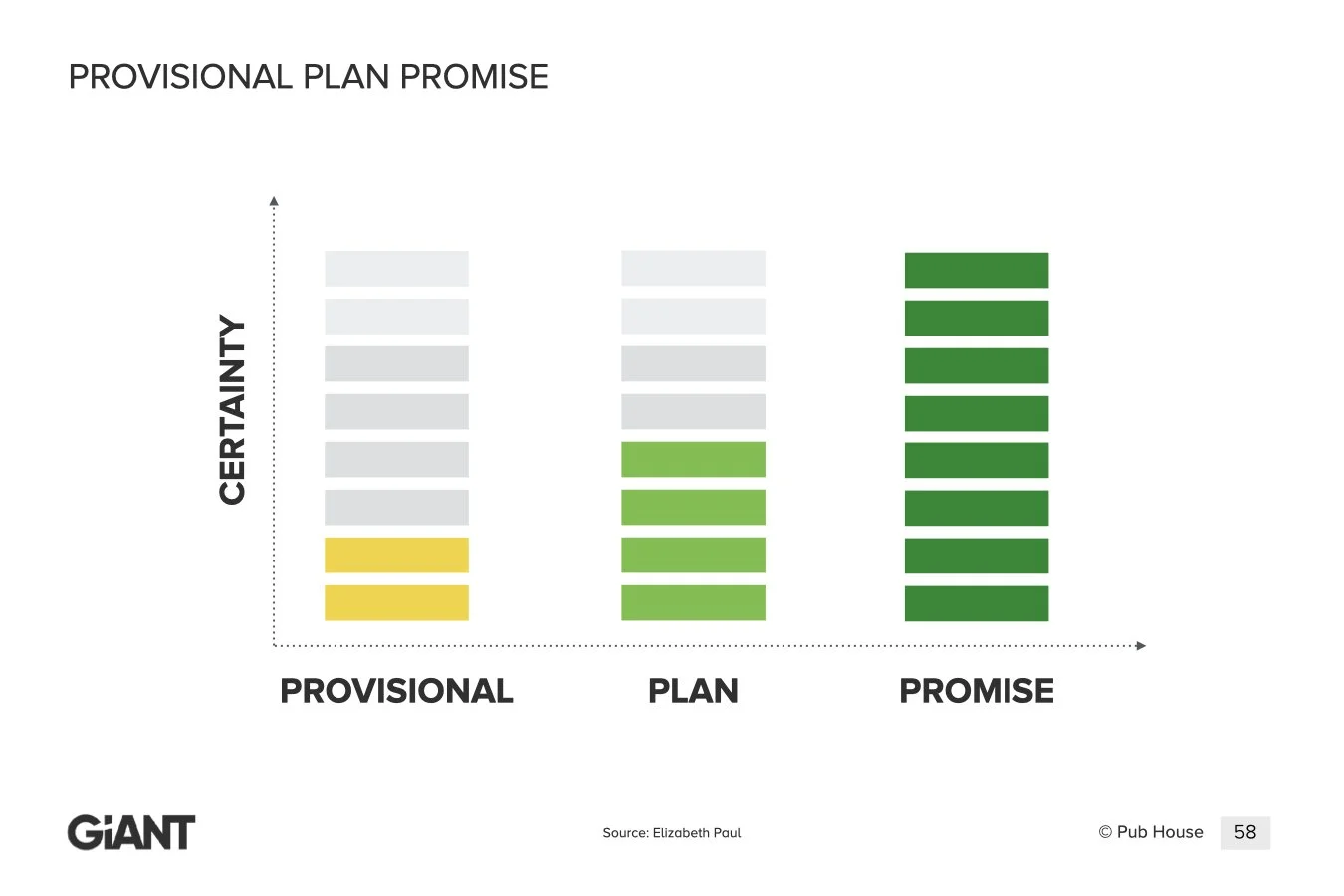
There’s a simple framework that helps solve this. It’s called Provisional Plan Promise.
It gives you three clear ways to communicate your intent:
Provisional: I’m thinking out loud. This is an invitation to collaborate, react and help shape the idea. Nothing is committed yet and it may or may not happen.
Plan: This is our intended direction. We’ve done the work and this is how we plan to move forward unless something changes. Now is the time to speak up with gaps, risks, or ideas to improve it.
Promise: This is a commitment. This will happen. Your integrity is attached to it and people can act on this with confidence.
You can also equip your team with a simple question: “Is this provisional, a plan, or a promise?” That one question creates clarity in real time and gives people permission to check assumptions before acting.
When teams use this language, expectations become clear. People know how to respond and how seriously to take what’s being said.
Why This Matters Now
Most teams are not lacking effort. They are lacking clarity.
When everything sounds the same, people don’t know what to act on. They either move too fast on something that was never real or hesitate on something that actually mattered.
That confusion slows execution, wastes time and creates frustration that builds over time.
Clear communication helps people know not just what you are saying, but how to respond.
The Result
If you start using this tool, things begin to settle.
People stop guessing. They engage at the right level. They contribute when something is provisional and execute when it becomes a plan or a promise. Trust begins to rebuild because your words start to match reality.
If you don’t address it, the opposite happens.
People keep working hard, but with hesitation. They stop trusting direction. They protect themselves by holding back or double checking everything.
Over time, that frustration turns into disengagement or people deciding it’s not worth it.
Take Action
This week, label your communication before you speak. In your next meeting, clearly state whether what you are sharing is provisional, a plan, or a promise. Then invite your team to ask, “Is this provisional, a plan, or a promise?” when they are unsure.
If you want to go deeper, schedule a call with us. We can walk through how your communication is impacting your team and how to build more clarity, alignment and trust.
Closing the Loop
My friend isn’t frustrated because his boss lacks ideas.
He’s frustrated because he can’t tell which ideas matter.
A simple shift in language could save him hours of work, rebuild trust and change how that team operates.
Clarity does not happen by accident. It happens when you choose it.