
One Question That Can Change Your Culture
Welcome to another Toolkit Tuesday! Every week, our goal is to give you a practical leadership tool to put in your toolkit.
So There I Was . . .
Recently I was sitting with a business owner before an all-staff meeting. The company was growing, the team genuinely cared about each other and overall things were going well, but you could feel tension beginning to build beneath the surface.
Small frustrations were becoming side conversations. People were venting to coworkers instead of talking directly to the person they were frustrated with. Nothing had completely blown up yet, but you could already see the impact it was beginning to have on the culture. Trust was slipping, misunderstandings were growing and drama was slowly starting to spread through the team.
As we talked through it together, one thing became really clear. This was not actually a performance problem. It was a communication problem.
The Challenge
Most workplace conflicts do not begin with some huge issue. Usually it starts with small disappointments, unmet expectations or annoyances that never get addressed directly. Human nature pulls us toward talking about people instead of talking to people because honestly, it feels easier and less uncomfortable in the moment.
The problem is that the moment people begin processing frustration with everyone except the person involved, culture slowly starts drifting in the wrong direction. Gossip spreads, assumptions grow and trust slowly erodes. Leaders often unintentionally allow it because they think they are being supportive listeners, when in reality they are allowing unhealthy communication patterns to grow inside the team.
The Tool: Go to the Source
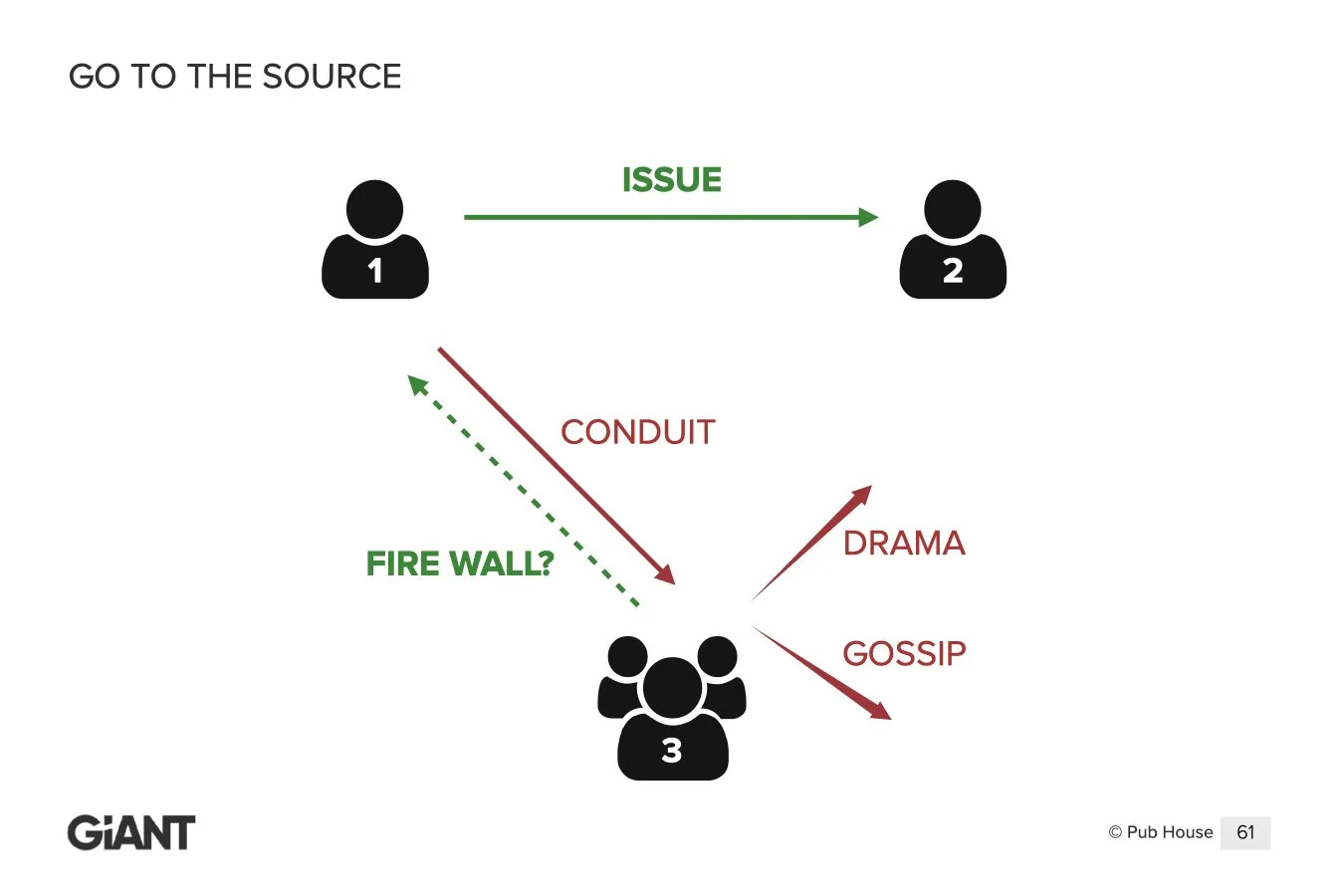
Go to the Source is one of the simplest and most powerful tools we use with teams because it creates shared language around healthy communication.
The idea is straightforward. If Person 1 has an issue with Person 2, they go directly to Person 2 and give them a chance to respond. Most of the time the other person does not even realize they caused frustration or offense.
When healthy direct conversations happen, relationships are often strengthened instead of damaged.
The important part of the tool is what happens when Person 1 is tempted to go talk to Person 3 instead. At that point Person 3 has a choice. They can become a conduit that spreads gossip and drama further into the organization, or they can become a firewall.
A firewall simply asks, “Have you gone to the source yet?”
That simple phrase creates accountability and clarity across the culture. Over time people begin to understand that the expectation is not to talk around problems but to address them directly, respectfully and with the goal of fighting for each other’s highest possible good.
Why This Matters Now
So many teams today are struggling with trust, alignment and communication, not because people are bad or intentionally divisive, but because unresolved tension quietly drains energy from the culture every single day.
When people do not feel safe or expected to communicate directly, gossip fills the gap. But when leaders consistently reinforce healthy communication patterns, trust begins to grow. Clarity improves. Execution improves. People stop protecting themselves and start genuinely working for each other’s success.
Ironically, when organizations focus on helping people become healthier, stronger and more connected, performance naturally improves as well. Productivity rises, collaboration becomes easier and the entire team becomes more aligned around the mission.
The Result
If a team refuses to deal with conflict directly, the culture eventually becomes reactive, political and emotionally exhausting. People spend more energy managing tension than solving problems.
But when leaders build a culture where healthy conversations are expected and supported, the environment changes. Drama loses oxygen.
Relationships become healthier. People become more honest and trust becomes stronger because issues are dealt with directly instead of spreading quietly underneath the surface.
This is not about controlling people or creating more rules.
It is about creating an environment where people can do their best work, become healthier versions of themselves and actually enjoy working together in the process.
Take Action
This week identify one conversation you have been avoiding and go directly to the source instead of processing it with someone else first. Have the conversation honestly, respectfully and with the goal of understanding instead of winning.
And if you want help building a healthier communication culture inside your team or organization, schedule a call with us. We would love to help you create the kind of environment where trust, clarity and accountability can actually grow.
Closing the Loop
That business owner walked into the all-staff meeting with a much clearer message for the team. This was not about creating more rules or policing people’s behavior. It was about creating a healthier culture through healthier communication.
Because strong cultures are not built by avoiding tension.
They are built when people learn how to handle tension the right way.
