The Takeout They Keep Passing Up
Welcome to another Toolkit Tuesday! Every week, our goal is to give you a practical leadership tool to put in your toolkit.
So There I Was . . .
I was sitting with a client, a successful business owner who works hard. I asked them specifically how they spend time on purpose as a family.
The answer was an ordinary weeknight.
Most nights my client and their spouse cook dinner at home. They're busy, and plenty of nights they're tired enough that takeout would make sense. Sometimes they do take the easier route, but that isn't the norm. Takeout every night just wasn't worth what it would cost them, and it was never really about the food. One cooks while the other spends time with the kids. Then they all sit down together, phones away, and eat. After dinner they swap. One cleans up and the other has the kids until bedtime.
What stuck with me was how intentional it was. Nobody in that house was confused about whether the kids mattered more than the work. They'd decided where the line was, and they keep coming back to it.
I walked away with a lot of admiration and a little discomfort, because I see the opposite far more often. And if I'm honest, it made me ask who gets my full attention when I walk through the door, and what I'm willing to give up to make that happen.
The Challenge
Ask most leaders whether their family matters more than their work and they'll say yes without blinking. But what we say matters most and what actually gets our best hours aren't always the same thing.
The pattern I see more often goes like this. The day runs long, so we stay late. We get home tired, eat whatever's fastest and open the laptop again once the kids are down. One more email. One more proposal. One more sale. None of it feels like a choice in the moment. It feels like responsibility. And the people at home rarely complain, at least not at first. They just quietly adjust to getting what's left.
And it isn't just home. It's the team member who asks you a question while you keep typing. It's the time you meant to recharge that quietly got eaten by one more task. The area of your life you ignore doesn't stay contained, either. When one part runs on leftovers long enough, it shows up somewhere else as distraction, tension or an exhaustion you can't quite explain.
The Tool: The Trade Up
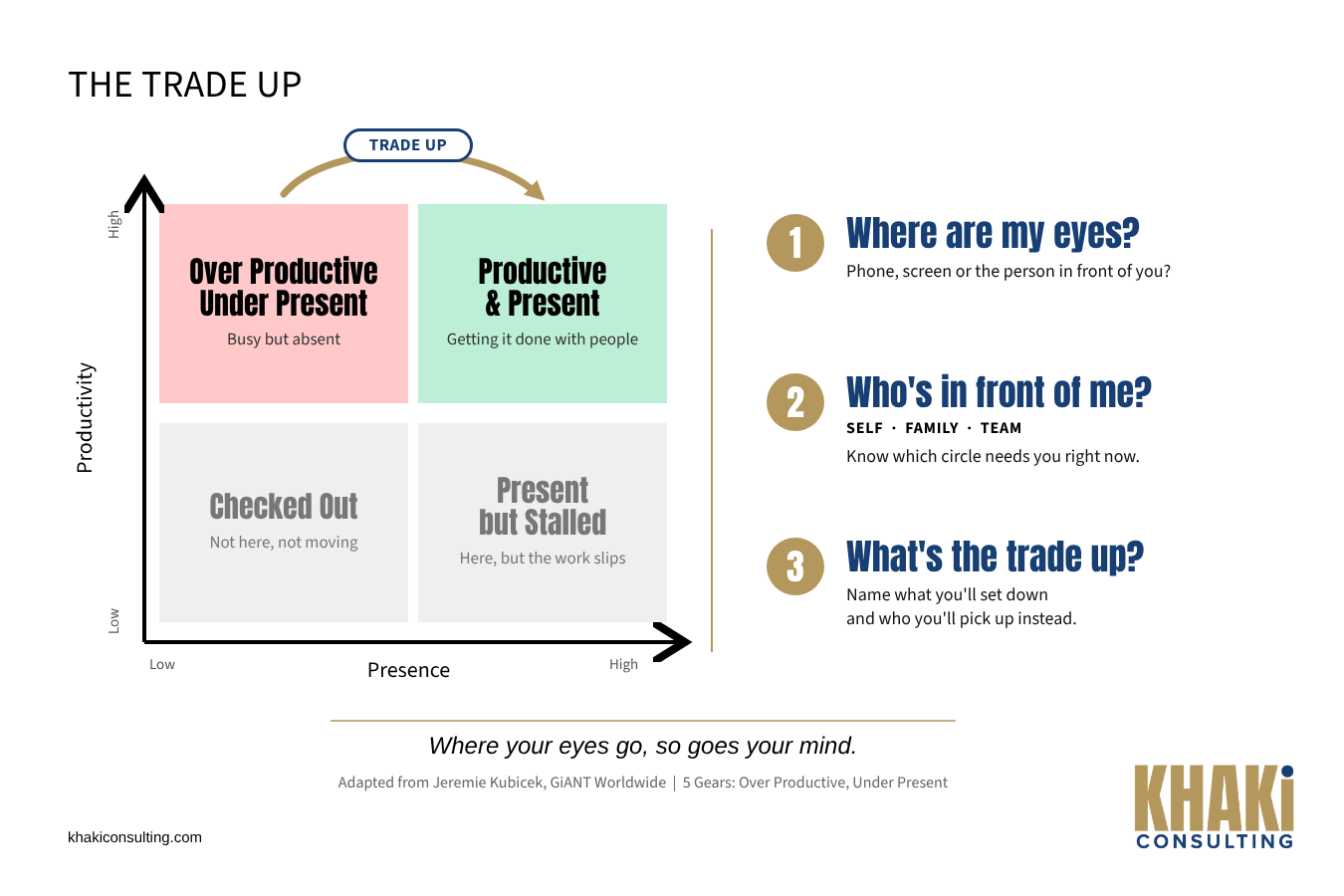
The Trade Up starts with a simple grid. One line is productivity: how much you get done. The other is presence: how much the people in front of you actually get you.
Put my client on that grid and three boxes fall away fast. They aren't Checked Out or Present but Stalled, because the work clearly gets done. And they aren't where most driven leaders live, Over Productive, Under Present, where the job gets the best hours and home gets the leftovers. They've built the fourth box: Productive and Present.
Getting there takes a trade up, and it starts with three questions you can ask in the moment. Where are my eyes? Where your eyes go, so goes your mind. That's why the phones go away at that table. Who's in front of me? Think about the inner three of the 5 Circles of Influence: Self, Family and Team (full breakdown here). The circles closest to the center usually pay first and complain last. What's the trade up? Name what you're setting down and who you're picking up instead. For my client it's takeout traded for an hour around the table.
The grid also gives you better language. "You're never really here" is hard to hear without getting defensive. "I've been living top left this month" is something you can work on together.
Why This Matters Now
We're in the fourth quarter now. For most leaders that means longer days, year-end pushes and a calendar that fills up fast.
To be fair, there are seasons when a project needs everything you've got. That's okay. Spending a stretch in the top left isn't the problem. Living there with no end in sight, and without telling anyone, is. "The next two weeks are going to be heavy, but here's when I'll come back up for air" lands completely differently than quietly disappearing. Stay there long enough without saying anything and it starts to feel normal. The people closest to you stop asking for more, and that silence is easy to mistake for things being fine. It usually isn't.
The Result
When you trade up, the people closest to you get the best of you instead of what's left. Your team gets a leader who looks up when they walk in. You get real time to recharge. And you get to keep your drive.
That's the real point. This isn't about balance for its own sake. It's about influence. When people consistently get your full attention, they don't have to guess whether you're for them. They know you're fighting for their highest possible good. My client proved to me that you don't have to choose between building something and being there for the people you're building it for.
Take Action
Put a dot on the grid for where you've lived the last 30 days. Then ask the person closest to you where they'd put it. Don't defend it. Just listen, and if you need to apologize, apologize.
If the answer stings or you're not sure where to start, let's grab time on the calendar and work through it together.
Closing the Loop
There's one part of my client's evening I keep coming back to: the swap. One cooks while the other is with the kids, then they trade places. It looks simple, but I'd guess it takes real effort to switch from the day they just had into the evening their family needs.
Next week we'll look at another tool that helps you and the people around you get in the right gear at the right time.