If Growth Depends on You, It Won’t Last
Welcome to another Toolkit Tuesday! Every week, our goal is to give you a practical leadership tool to put in your toolkit.
So There I Was . . .
So there I was, thinking back over the last few weeks.
Not one conversation or one moment, but a growing awareness. We talked about the challenges of leading in a digital world. We talked about engagement and how it naturally drifts when we are not intentional. We talked about culture and how it is shaped whether we pay attention or not.
Different tools. Different angles. But they all kept pointing to the same thing.
What actually works and what quietly breaks when it comes to developing people.
This wasn’t new for us at Khaki Consulting. If anything, it reinforced the why behind what we do. Over and over again, across industries and organizations of every size, we see the same pattern. Leaders care deeply. They work hard. But without a consistent and scalable way to develop people, everything feels heavier than it should.
That reinforcement matters, because it explains why this approach keeps working.
The Challenge
The challenge is not that leaders are unwilling to develop their people. Most leaders genuinely want their teams to grow and succeed.
The challenge is that people development is rarely designed to scale. It often lives in one on one conversations, depends on a few strong leaders, and shows up when there is margin. When things get busy, it fades into the background.
Over time, this creates tension. Some people grow quickly while others stall. Expectations feel unclear. Culture becomes dependent on who you report to rather than something the whole organization shares.
When leadership language is subjective, when tools are overly complex, or when growth is modeled by only a handful of people, the system eventually breaks down.
Good intentions alone cannot carry the weight of healthy, sustainable people development.
The Tool: Scalable People Development
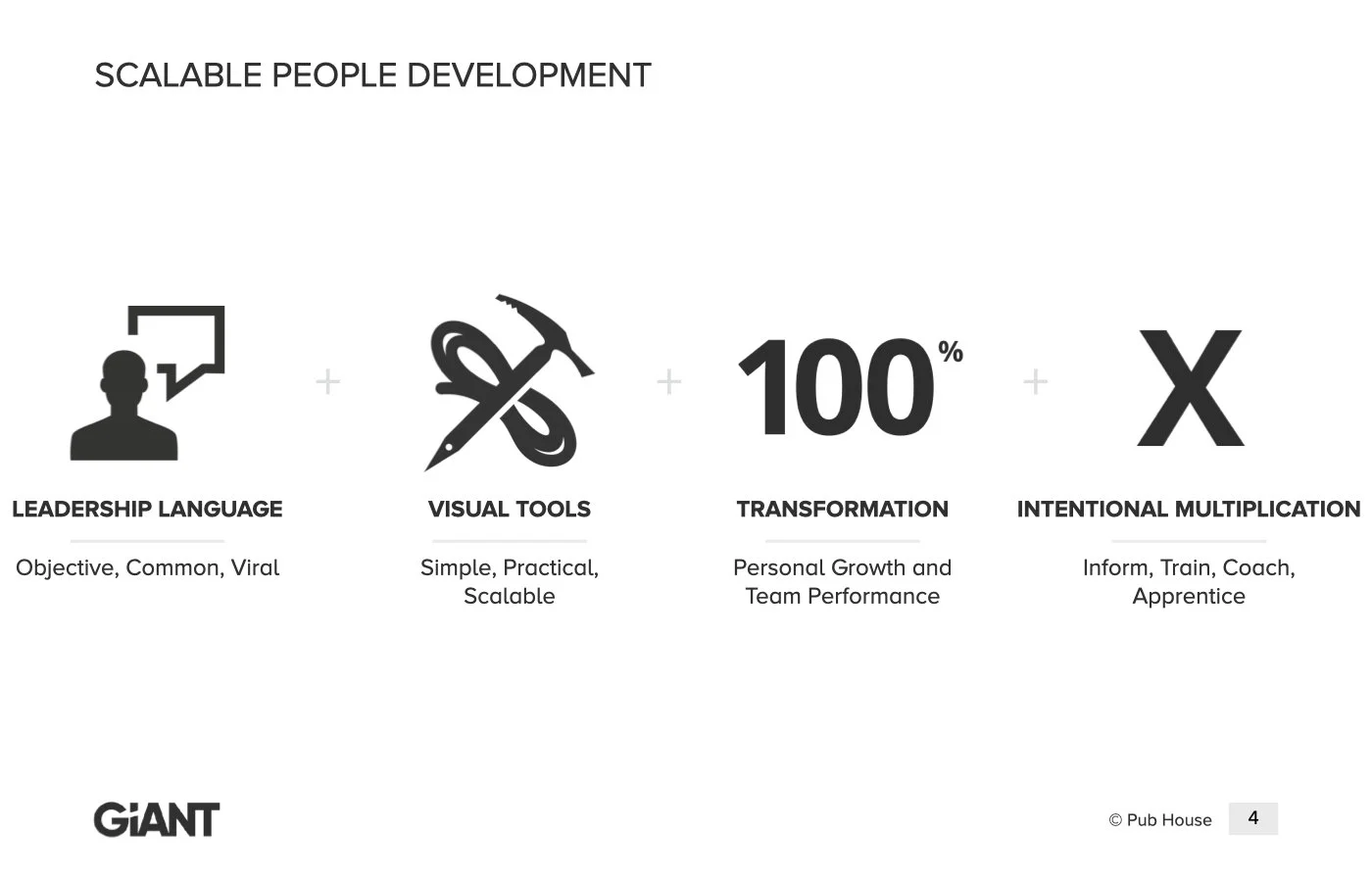
Scalable People Development is not a single tool you use in a meeting. It is a way of thinking about how people actually grow inside an organization. At its core, it is about taking complex leadership ideas and making them simple enough that everyone can understand and use them.
When development is simple, it can scale.
There are four ingredients that make this work.
Leadership Language - Everything starts with a common language. One that is objective, not subjective. When people agree on what words mean, conversations become clearer and accountability becomes fair. A shared language allows teams to engage without confusion or unintended offense.
Visual Tools - Language sticks when it is reinforced visually. Simple tools give people a shared reference point they can use in real moments, not just training sessions. If you can draw it and explain it, you can use it anywhere.
Personal Transformation - You cannot give what you do not possess. Healthy cultures are built by leaders who are willing to work on themselves first. The goal is to move toward greater health, clarity, and self awareness before pointing out what needs to change in others.
Intentional Multiplication - Growth only scales when people know how to pass it on. This is about being intentional in developing others, not creating dependence. Healthy leaders multiply healthy behaviors and attitudes throughout the organization.
When these four elements work together, people development becomes consistent, repeatable, and scalable.
Why This Matters Now
The pace of work is not slowing down. Expectations are higher. Attention is more fragmented. And leaders are carrying more than ever.
In that environment, inconsistent people development shows up fast. Engagement drifts. Misalignment grows. Culture becomes fragile instead of resilient.
What used to be small gaps are now exposed quickly. When language is unclear, tools are complicated, or growth depends on a few strong leaders, the system cannot keep up with the pressure.
This is why scalable people development matters now more than ever. Leaders do not need more content or more complexity. They need simple, shared, and repeatable ways to help people grow in real time.
When development scales, leaders stop carrying everything themselves. Teams become more resilient. Culture becomes something people live, not just talk about.
The Result
When leaders commit to scalable people development, things start to shift in meaningful ways.
Growth stops being uneven. People are no longer guessing what good leadership looks like or how they are expected to show up. Conversations become clearer because everyone is using the same language and the same tools.
Leaders feel less pressure to carry everything themselves. Instead of being the bottleneck, they become multipliers. Teams grow more resilient, more aligned, and more capable of navigating change without constant intervention.
But when this is ignored, the opposite slowly takes hold. Development stays inconsistent. A few strong leaders prop things up while others fall behind. Culture becomes fragile and performance suffers, even though effort remains high.
The difference is not intent. It is whether growth is designed to scale.
Healthy cultures do not happen by accident. They are built when people development is shared, simple, and multiplied across the organization.
Take Action
Start by taking an honest look at how people development really happens in your organization. Not what you hope is happening, but what actually scales beyond you. Identify where growth depends on your presence, your energy, or your availability. Choose one area where you can begin simplifying and sharing development instead of carrying it alone.
Then, if you want help building something that lasts, schedule a conversation with us. We can talk through how to create a shared language, simple tools, and a clear process that fits your team and actually works.
Closing the Loop
As I think back over the last few weeks, the theme keeps repeating itself.
Leadership challenges change. Engagement rises and falls. Culture shifts with pressure.
But one thing remains true. When people development is simple, shared, and multiplied, teams grow healthier and leaders stop carrying the weight alone.
At the end of the day, scalable systems matter, but people matter more. And when you build with people in mind, growth has a way of reaching further than you ever could on your own.