Why Leadership Books Do Not Create Healthy Culture
Welcome to another Toolkit Tuesday! Every week, our goal is to give you a practical leadership tool to put in your toolkit.
So There I Was . . .
So there I was last November, facilitating a workshop with leaders from all kinds of industries. Different roles. Different challenges. Same desire to lead well.
We had a plan for the day, and the Support Challenge Matrix was not on it. But a question came up that could not be answered with advice alone. It needed clarity.
So we grabbed a whiteboard and started sketching the tool, simply to help the answer rise to the surface. As I drew and explained it, something shifted. People pulled out their phones and started taking pictures of the board. Others copied it down in their notebooks, adding their own notes alongside it.
Nothing on the board was new. But it was finally visible.
Later, the feedback was consistent. People said it felt like something unlocked for them. Like looking in a mirror. They could see blind spots and negative tendencies that had been quietly undermining their influence and leadership.
The Challenge
This is the challenge most leaders face.
They know what healthy leadership should feel like. Many of them have bookshelves full of the best leadership books and conference notebooks packed with great ideas. But those things, by themselves, do not create culture.
The real struggle is not knowledge. It is translation.
Without shared language, leaders struggle to explain what they see, feel, or expect clearly enough to themselves or to others. Feedback becomes personal an misalignment turns into frustration. Culture quietly erodes, especially when pressure increases.
The Tool: Creating Healthy Culture
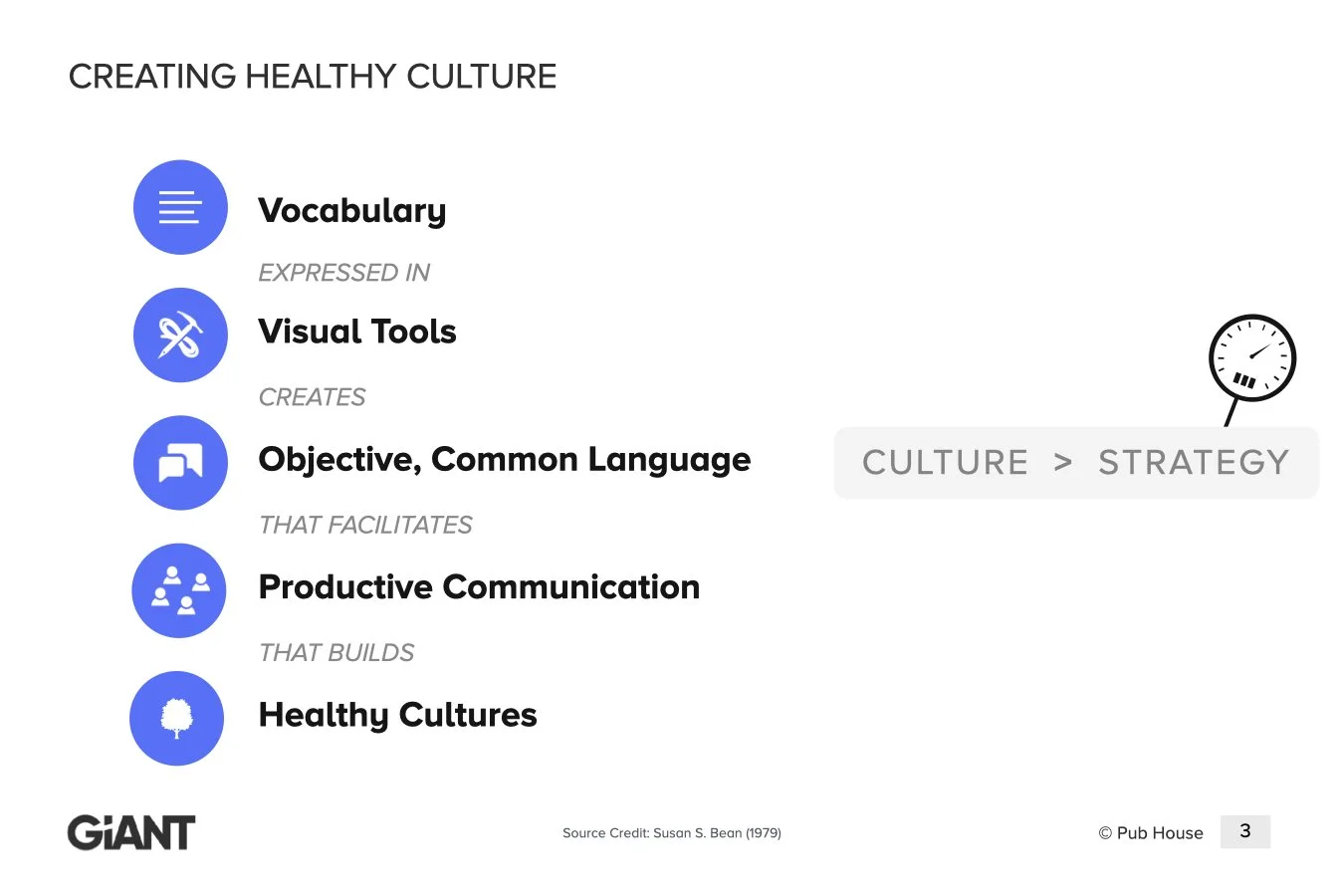
Over the years, we have seen that healthy culture does not happen by accident. It is built through a clear sequence that gives teams the language and clarity they need to work well together.
Vocabulary - Healthy culture starts with shared words. When leaders and teams use the same language, assumptions decrease and clarity increases.
Visual Tools - That vocabulary must be visible. Visual tools make abstract ideas concrete, memorable, and easy to return to under pressure.
Objective, Common Language - When language becomes objective instead of subjective, conversations feel safer. People are no longer debating intent or personality, but naming reality together.
Productive Communication - Shared language changes how people talk. Feedback becomes clearer. Coaching becomes normal. Conflict becomes more constructive.
Healthy Culture - Over time, these communication patterns build trust and relational strength. This is why culture consistently outweighs strategy, especially when pressure is high.
Healthy culture is not created by adding more information. It is created when leaders give their teams a better way to understand themselves and one another.
Why This Matters Now
Leading in the digital age only magnifies this reality.
Teams are more dispersed. Communication is constant. Influence often matters more than authority.
Without common language, assumptions multiply and misunderstandings harden. Even strong leaders begin to feel disconnected from their teams.
But when leaders intentionally create shared vocabulary and rhythms of learning, clarity returns. People know how to engage, challenge, and support one another well.
The Result
When leaders commit to creating a healthy culture, people experience relief, not just results.
They feel seen. Conversations become clearer. Coaching becomes normal instead of threatening. Collaboration becomes possible without forcing it.
When leaders do not, even talented and well intentioned teams struggle. Culture does not stay neutral. It either strengthens or slowly breaks down.
Take Action
This week, think about one recurring conversation on your team that feels heavy or unclear. Ask yourself what shared language might be missing and how a simple visual tool could change that dynamic.
And if you want to talk through how to establish a healthier culture and common language on your team, schedule a call with us. We would love to help you think through what that could look like.
Closing the Loop
Whenever we cover a tool with someone, we always send it to them afterward along with an open invitation to talk more.
That posture matters to us. Help first, help always.
Toolkit Tuesday exists for the same reason. It is about putting tools in leaders’ hands so they can lead with clarity and confidence.
Our goal is simple. To help liberate 100k leaders so people can experience healthier leadership where they work every day.