Is Your Leadership Creating Ownership or Silence?
Welcome to another Toolkit Tuesday! Every week, our goal is to give you a practical leadership tool to put in your toolkit.
So There I Was . . .
I was working with a department leadership team during one of our consulting sessions earlier this year when one of the senior executives joined the room. At first, it seemed helpful. They were engaged, energetic and clearly wanted to contribute. But almost immediately, every question I asked got answered by the executive first. Before the room had time to think. Before anyone else had space to respond.
When managers shared challenges, the executive responded with stories about pushing harder, working longer and figuring it out without complaining. Then the room shifted. At one point, the executive openly criticized the department’s operations in front of the group. Not maliciously. Almost casually.
After that, participation became transactional. Shorter answers. Less honesty. Less collaboration.
A few days later, the department leader told me, “You noticed how my boss acted during that session? That’s how it is all the time.”
The Challenge
One of the hardest realities for leaders to accept is this: The behaviors that helped you succeed earlier in your career can eventually become the very things limiting your team.
Many leaders rise because they know how to push. They drive results. Solve problems quickly. Handle pressure well. Those are valuable leadership skills.
But if Push becomes your default mode, eventually people stop bringing you the full truth because they’ve learned there isn’t much room for their perspective in the conversation.
Over time, teams stop collaborating and start managing the leader instead.
And most leaders have no idea it’s happening.
The Tool: Push Pull Behaviors
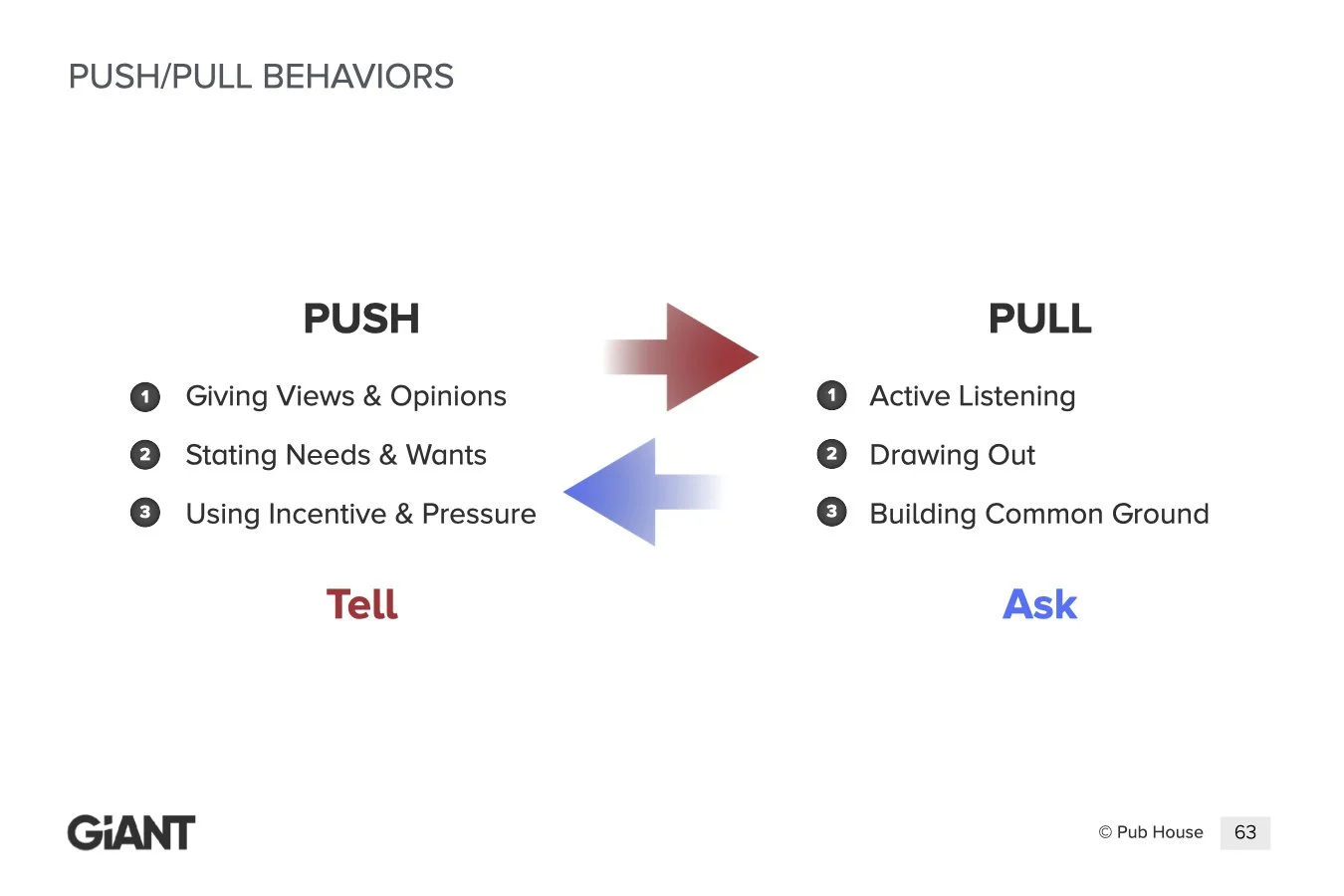
The Push/Pull framework is one of the simplest and most practical coaching tools I’ve seen for leadership communication.
Push behaviors are the skills most leaders are naturally rewarded for:
bringing direction, clarity, challenge, expectations, pressure and decisiveness.
Pull behaviors are different. They involve asking questions, listening well, drawing out perspectives, creating space and building common ground.
Healthy leadership requires both.
Too much Pull and leaders avoid challenge, accountability and clarity.
Too much Push and leaders unintentionally dominate conversations, shut down feedback and create compliance instead of ownership.
The goal is not becoming less decisive. It’s becoming more aware.
The best leaders know when the moment requires clarity and challenge, and when the moment requires curiosity and listening.
Why This Matters Now
Most organizations don’t struggle because leaders care too little. They struggle because leaders unintentionally overuse the behaviors that made them successful in the first place.
The higher leaders rise, the more dangerous this becomes. At executive levels especially, leadership becomes less about personally solving problems and more about creating an environment where other people can contribute at a high level.
If leaders only Push, eventually the organization loses honesty, creativity and healthy challenge. And once that happens, culture starts becoming transactional.
The Result
When leaders learn to balance Push and Pull behaviors, teams begin to respond differently. People speak up sooner. Meetings become more collaborative. Feedback becomes healthier. Accountability improves because people actually feel heard before they’re challenged.
Most importantly, leaders stop carrying the entire weight of the organization themselves.
Because high-performing teams are not built through pressure alone.
They’re built through a combination of challenge and trust.
Take Action
This week, when you walk out of your next meeting, ask yourself: Did people leave feeling managed or developed? There’s a difference.
And if you want to build a healthier coaching culture where leaders know how to balance challenge, accountability and trust, schedule a strategic conversation with us here:
Closing the Loop
I’ve thought about that room several times since that session.
Not because the senior executive was a bad leader. In truth, that leader had achieved significant success throughout their career. But success has a way of reinforcing behaviors that can quietly limit us over time.
Imagine how much further they could go with some adjustment in how they lead, balancing more Pull with their Push. Especially when nobody feels safe enough to tell them how they are landing on the people around them.
Sometimes the room gets quiet long before the leader notices.