What’s Confusion Costing You?
Welcome to another Toolkit Tuesday! Every week, our goal is to give you a practical leadership tool to put in your toolkit.
So There I Was . . .
Before every flight mission I ever flew in the Army, we gathered for a briefing before anyone left the ground.
Everyone needed to understand the mission, the commander's intent, and how their role contributed to the bigger picture. As a young pilot, I sometimes wondered why we spent so much time reviewing things that seemed obvious.
Years later, I realized those briefings weren't really about sharing information. They were about creating clarity.
The leaders understood something I didn't fully appreciate at the time: confusion gets expensive.
The Challenge
The problem is that most leaders don't realize they have a clarity problem. Instead, they see the symptoms.
The same questions keep coming up. Priorities seem to shift. Decisions take longer than they should. Leaders find themselves stepping into issues they thought someone else owned.
The natural response is to push harder on accountability. But accountability isn't usually the starting point.
If I walked through your organization and asked ten people what the mission is, would I get ten similar answers or ten different ones? If I asked them what the top priorities are right now, would they agree? If I asked who owns a key decision, would there be any hesitation?
Most people aren't trying to create confusion. They're trying to do a good job. They're just operating from different assumptions. And when people are working from different assumptions, even great teams struggle to execute.
That's why clarity matters.
Clarity around the mission. Clarity around priorities. Clarity around roles and responsibilities. Clarity around how each person's work contributes to the bigger picture.
Because confusion isn't just frustrating. It's expensive.
The Tool: Organizational Clarity
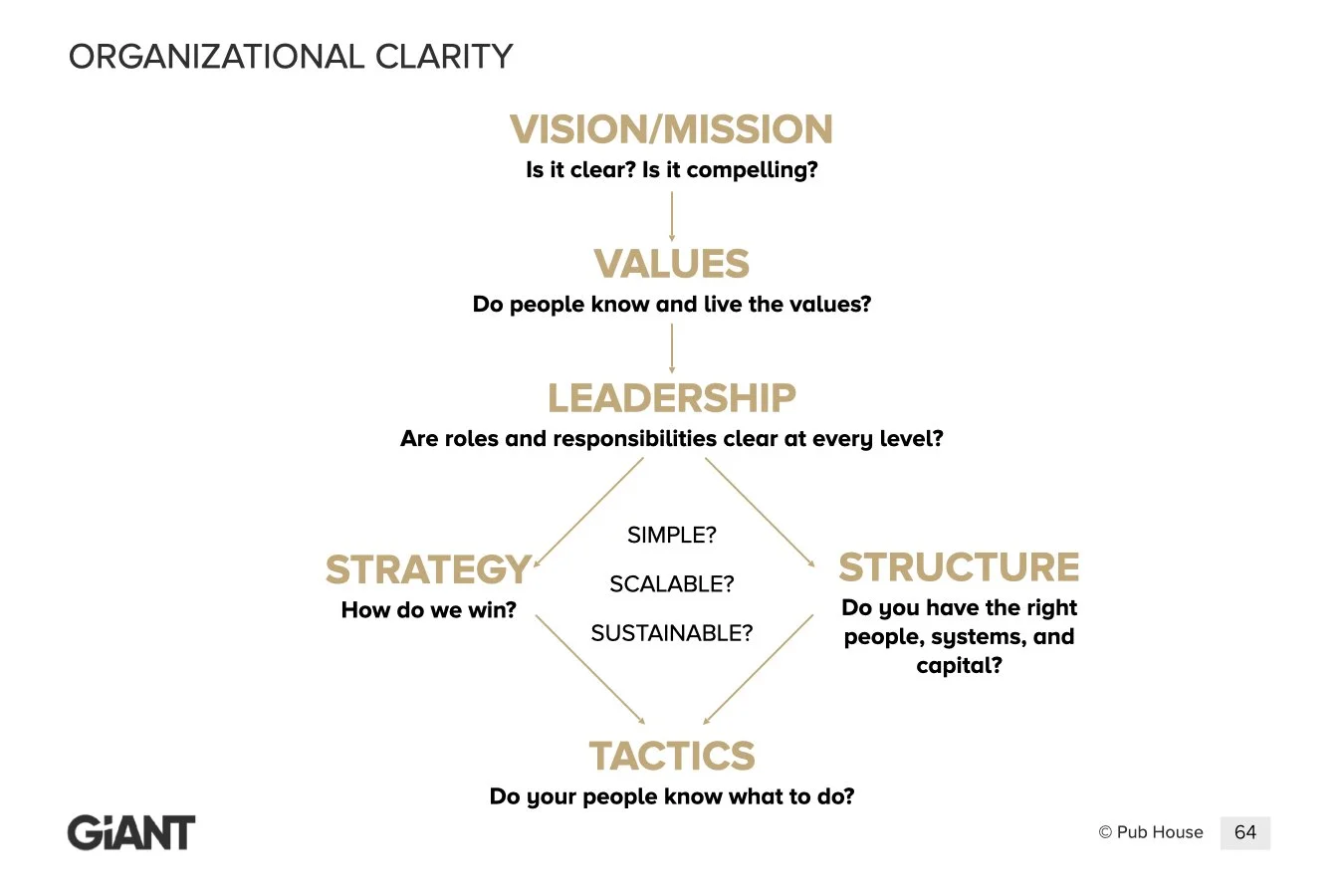
One of my favorite tools for helping leadership teams eliminate confusion is the Organizational Clarity framework.
The framework helps leaders evaluate seven areas that drive alignment: Leadership, Vision, Values, Strategy, Culture, Structure, and Tactics.
The question isn't whether these things exist. The question is whether they're clear.
Do people understand their roles and responsibilities? Is the vision compelling? Are the values being lived? Does everyone know how the organization wins and what matters most right now?
When clarity is missing in any of these areas, confusion begins to creep in. Priorities compete, decisions slow down, and teams start pulling in different directions.
The goal isn't perfection. The goal is identifying where clarity is missing before confusion becomes costly.
Why This Matters Now
Most organizations don't struggle because of a lack of effort.
They struggle because growth creates complexity, and complexity exposes a lack of clarity.
As teams grow, assumptions multiply. People begin interpreting priorities differently. Decision-making slows. Leaders find themselves stepping back into problems they thought they had delegated.
The organizations that scale well aren't necessarily the ones with the best people.
They're the ones where people are clear on the mission, clear on their role, and clear on what matters most.
Clarity creates alignment. Alignment drives execution.
The Result
When organizational clarity improves, ownership improves.
People make better decisions because they understand the mission. Teams collaborate more effectively because they understand how their work connects to others. Leaders spend less time firefighting because expectations are clearer.
The result isn't just better performance.
It's a healthier organization where people can move faster with greater confidence and less frustration.
Take Action
First, gather your leadership team and have each person rate the seven areas of Organizational Clarity on a scale from one to ten.
Then compare scores.
Don't focus on the highest ratings. Focus on where the answers are different. Those gaps often reveal where assumptions have replaced clarity and where confusion may already be costing your team time, energy, and momentum.
Second, if you'd like help creating greater alignment across your leadership team and organization, let's have a conversation. Helping leaders create clarity that drives execution is one of the things we do best.
Closing the Loop
Looking back, those mission briefings weren't about information. They were about clarity.
The military understood something many organizations still miss: people can't execute a mission they don't understand.
Most organizations don't need people to work harder.
They need people pulling in the same direction.