That’s Not the Price of Leadership
Welcome to another Toolkit Tuesday! Every week, our goal is to give you a practical leadership tool to put in your toolkit.
So There I Was . . .
So there I was sitting down with the General Manager of one of our clients when the conversation turned to his upcoming family vacation. He was excited about the trip, but then he started telling me his plan.
He would get up early each morning before his family, take his laptop down to the hotel lobby or out by the pool and check in on the store before everyone else woke up.
Emails. Issues. Questions. Decisions.
The more he talked, the more it sounded like he wasn't going on vacation. He was just moving his office.
What stood out wasn't the laptop. It was how normal it sounded. He wasn't frustrated. He wasn't complaining. He genuinely believed this was part of the job.
Then he said something I've heard from a lot of leaders. "That's just the price of leadership."
I remember sitting there thinking, no it isn't. At least it shouldn't be.
The Challenge
Before we're too hard on that General Manager, let's be honest.
He's accountable for results. His leaders expect growth. His team depends on him to perform.
That's not the problem.
The problem is that many leaders start believing that being needed is the same thing as leading.
If everyone calls them, they must be valuable. If every decision runs through them, they must be important. If they can't disconnect, that must mean they're doing their job.
For a while, that mindset works. But eventually the leader becomes the system.
Every problem requires their involvement. Every decision waits on their approval. Every vacation becomes a working vacation.
The issue isn't effort. The issue is clarity.
The Tool: Clarity Tool
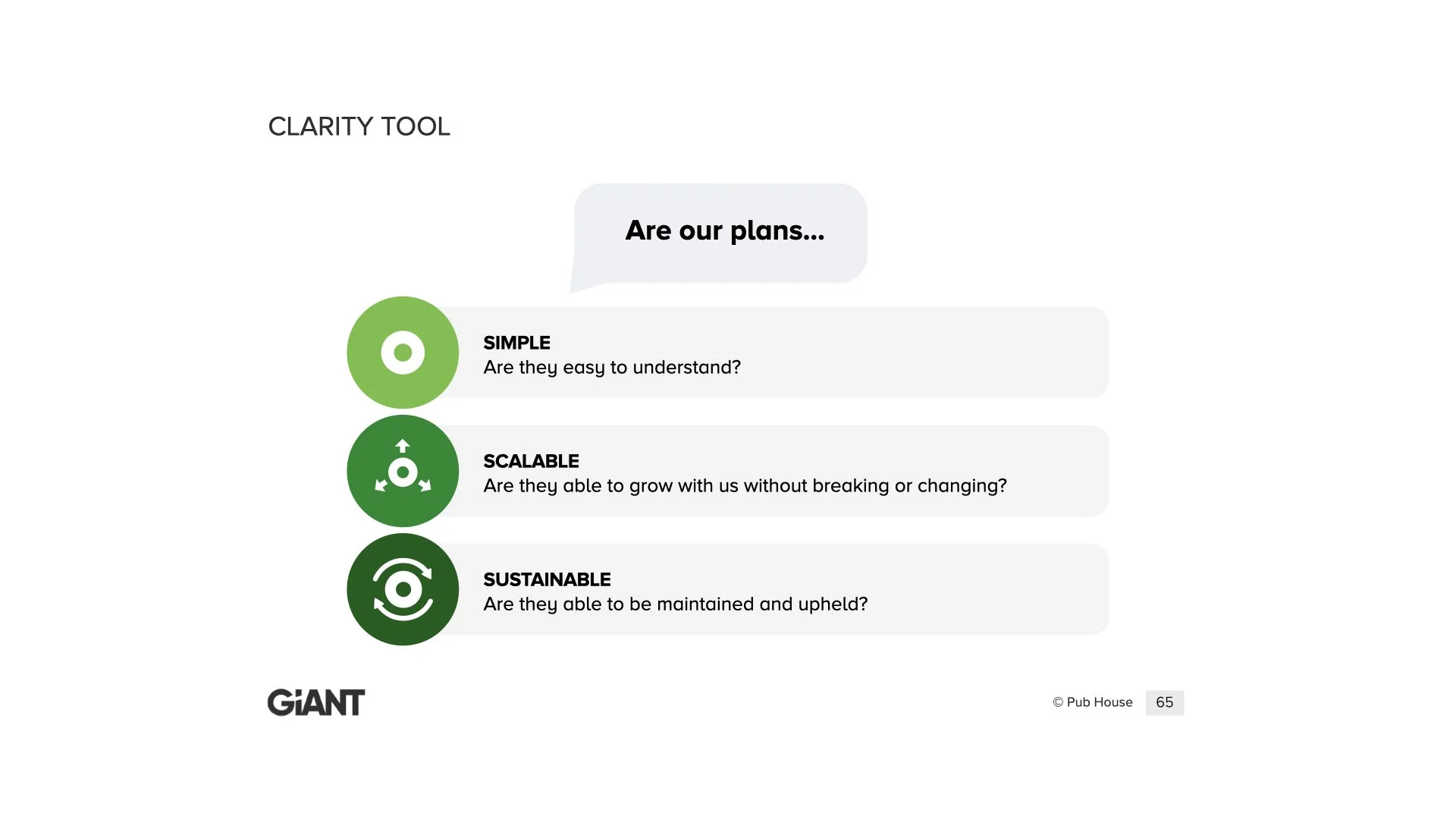
The Clarity Tool gives leaders a simple way to evaluate a project, process, initiative or even their entire business. It asks three question:
Is it Simple? Is it Sustainable? Is it Scalable?
Most leaders focus on the last question first. They want growth. More customers. More locations. More revenue. More responsibility.
But scale comes last.
First, people have to understand what they're doing and why it matters. If your team can't explain the plan, they probably don't understand it. And if they don't understand it, they won't own it.
Then comes the question many leaders overlook. Is it sustainable?
Can the work continue without you constantly checking in? Can your team make decisions without waiting for permission? Can things keep moving when you're on vacation, in a meeting or simply unavailable?
If the answer is no, you've built dependency instead of sustainability.
Only after something is simple and sustainable can it truly become scalable. That's when growth stops depending on heroic effort and starts depending on clarity.
Why This Matters Now
Most leaders don't become bottlenecks on purpose; they become bottlenecks because they're trying to help by answering questions, solving problems, making decisions, and filling gaps.
Over time, the team learns that the fastest path forward is through the leader, but without clarity, ownership shrinks, dependency grows and growth eventually slows down.
The Result
When leaders create clarity, people stop waiting and start acting.
Teams become more confident because they understand what's expected. Ownership increases because decisions no longer have to run through one person. Leaders gain freedom because they can step away without everything grinding to a halt.
The goal isn't to make leaders less important.
The goal is to build systems and teams that don't require heroic effort to succeed.
Take Action
First, think about one responsibility, decision or process in your business that would struggle if you disappeared for two weeks. Then ask yourself:
"What would need to change for this to continue without me?"
Start there.
Second, if you'd like help identifying where your organization may be creating unnecessary dependency, let's schedule a conversation.
Closing the Loop
I keep thinking about that General Manager sitting by the pool with his laptop open while his family slept.
He believed the business needed him. Maybe it did. But that's not the goal of leadership.
The goal is to create enough clarity that the business can thrive without you.
That's what makes it sustainable.