The Culture You Didn't Mean to Build
Welcome to another Toolkit Tuesday! Every week, our goal is to give you a practical leadership tool to put in your toolkit.
So There I Was . . .
So there I was, sitting in on a meeting with a client's management team. We opened with a simple question: what's the most challenging leadership issue you're facing right now? One of the managers didn't hesitate.
He said it was one person on his team, long-tenured, who'd already made it clear, in ways direct and not so direct, that they didn't see the point of learning the new system the company was rolling out. "They've been here so long, I don't know if we can really push them on this."
I asked why not. The honest answer was fear, of an uncomfortable conversation, maybe even a resignation, from someone who'd been loyal for over a decade and always gotten raises just for showing up. But the manager's real worry wasn't this one person, it was everyone else watching. Let it slide, and the message to the rest of the team writes itself: you don't have to grow to get paid more. Nobody wanted to be the one who said it first.
The Challenge
This is what happens when leaders avoid accountability long enough. It eventually gets baked into the system itself. This particular company had a compensation structure built almost entirely around tenure, raises for years served rather than performance or growth. Loyalty got rewarded. Adaptability didn't. Over time, that created a top-heavy team where the longest-tenured people had the least reason to change and the most to lose if they did.
None of this happened because anyone set out to build a culture like that. It happened because leadership kept choosing the easier conversation over the harder one, one small avoidance at a time, until the avoidance became the culture.
The Tool: Accountability Curve
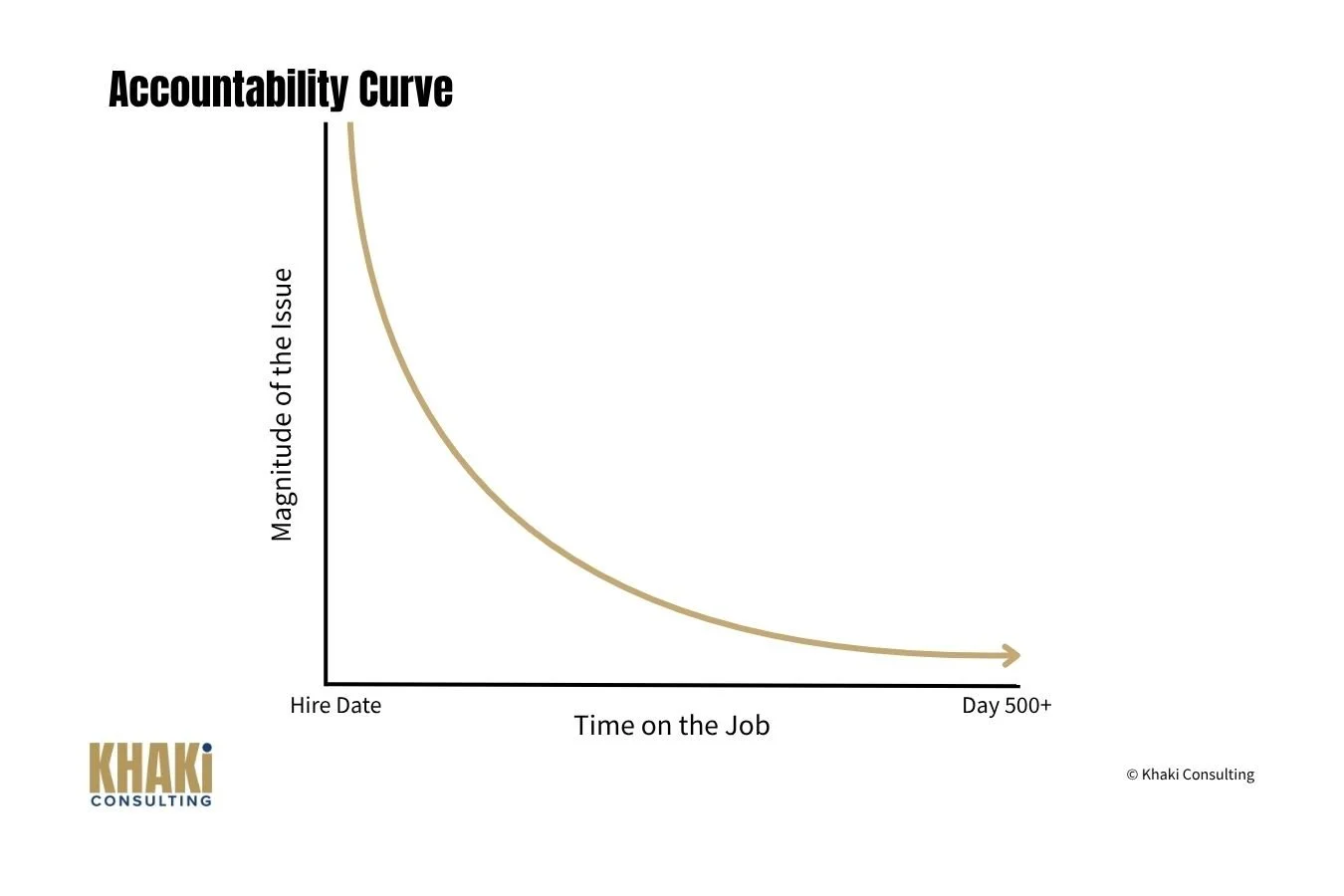
We call this the Accountability Curve. Usually we talk about it in terms of a new hire's first thirty, sixty, ninety days, because that's when a leader's response to small things carries the most weight. But the curve doesn't only reset when someone new walks in the door. It resets anytime a leader introduces a new expectation, including right now, with a system everyone on the team is being asked to learn.
It gives leaders shared language for timing instead of arguing over who deserves a pass. This team is at day one of a new standard, and holding it for everyone teaches what actually matters.
Holding the line doesn't mean firing someone for being loyal. It means redefining what earns a raise: real value, not years logged. If this person can keep contributing on the legacy system, that's fair. If not, keeping them at the same pay to dodge the conversation isn't loyalty, it's avoidance.
Why This Matters Now
If leadership lets this slide again, they're not protecting one loyal employee. They're making another deposit into the same pattern that already built a top-heavy, tenure-rewarded culture.
Left unaddressed long enough, avoided accountability doesn't just stall a system rollout. It calcifies into a culture. Sometimes a protecting culture, one that shields people from ever facing consequences. Sometimes a dominating culture, where the loudest resistance wins. Sometimes an abdicating culture, where nobody's willing to hold the line on anything. None of those get chosen on purpose. They get built one avoided conversation at a time.
The Result
Leadership teams that hold the line at moments like this don't need to be harsh about it. They just need to be clear and consistent, for the newest hire and the twenty-year veteran alike. Do that, and the standard becomes real for everyone, not just the easy targets. Avoid it, and the standard only ever applies to the people with the least power to resist it, which isn't a standard at all.
Take Action
First, name one place you've let the Accountability Curve slide, a standard you enforce for some people but quietly let someone else opt out of because they've earned an invisible pass. Then decide what actually holding the line with them looks like, and follow through the same way you would with anyone else.
Second, if you're staring down a rollout, a policy, or a standard you're not sure how to enforce evenly, let's grab time on the calendar and work through it together.
Closing the Loop
That leadership team hasn't decided yet what they're going to do about that employee. Last I heard, they were still weighing it, still hoping for a way around the hard conversation altogether. I don't know which way they'll go. But I know the system doesn't care how long anyone's been there. It's rolling out either way. The only real question left is whether leadership rolls out the standard right alongside it.