What Kind of Resistance Is This?
Welcome to another Toolkit Tuesday! Every week, our goal is to give you a practical leadership tool to put in your toolkit.
So There I Was . . .
Last week I told you about a manager I'm coaching. Leadership kept going around him, siding with his team without ever sending them back to talk to him first, then turning around and telling him he needed to do more. I said I didn't have a clean ending for that one. I still don't. But something shifted in our next session that changed how he was looking at it.
Session after session, the same frustration kept resurfacing. Leadership kept usurping decisions that were his to make. He couldn't do the job they'd brought him in to do, because every time he tried, someone above him stepped in and reversed it. More than once he asked some version of the same question: why did they even hire him in the first place?
On the surface, that sounds like a wall. Leadership is leadership, nothing he can do about it, just live with it or work around it. That's where he'd landed.
But a wall is only one kind of resistance, and it's worth asking whether it's the right one before you settle there. So we sat with it together: was this something he truly couldn't change, something he could push through with enough effort, or something missing that nobody had ever put in place?
I didn't have an answer for him that day.
The Challenge
We do this constantly. Something gets in our way, and before we've even looked closely at it, we've already decided what kind of resistance it is. Usually we decide it's the hardest kind. A wall. Unmovable. Out of our hands.
But not all resistance is the same weight, and treating it like it is costs you. If you call a hurdle a wall, you stop trying before you've even jumped. If you call a gap a wall, you wait around for someone to change who they are, when all you actually needed was to fill in something that was missing.
The manager I'm coaching had been treating his situation as the first kind, the immovable kind. Whether that's actually true is exactly what we're about to figure out.
The Tool: Overcoming Resistance
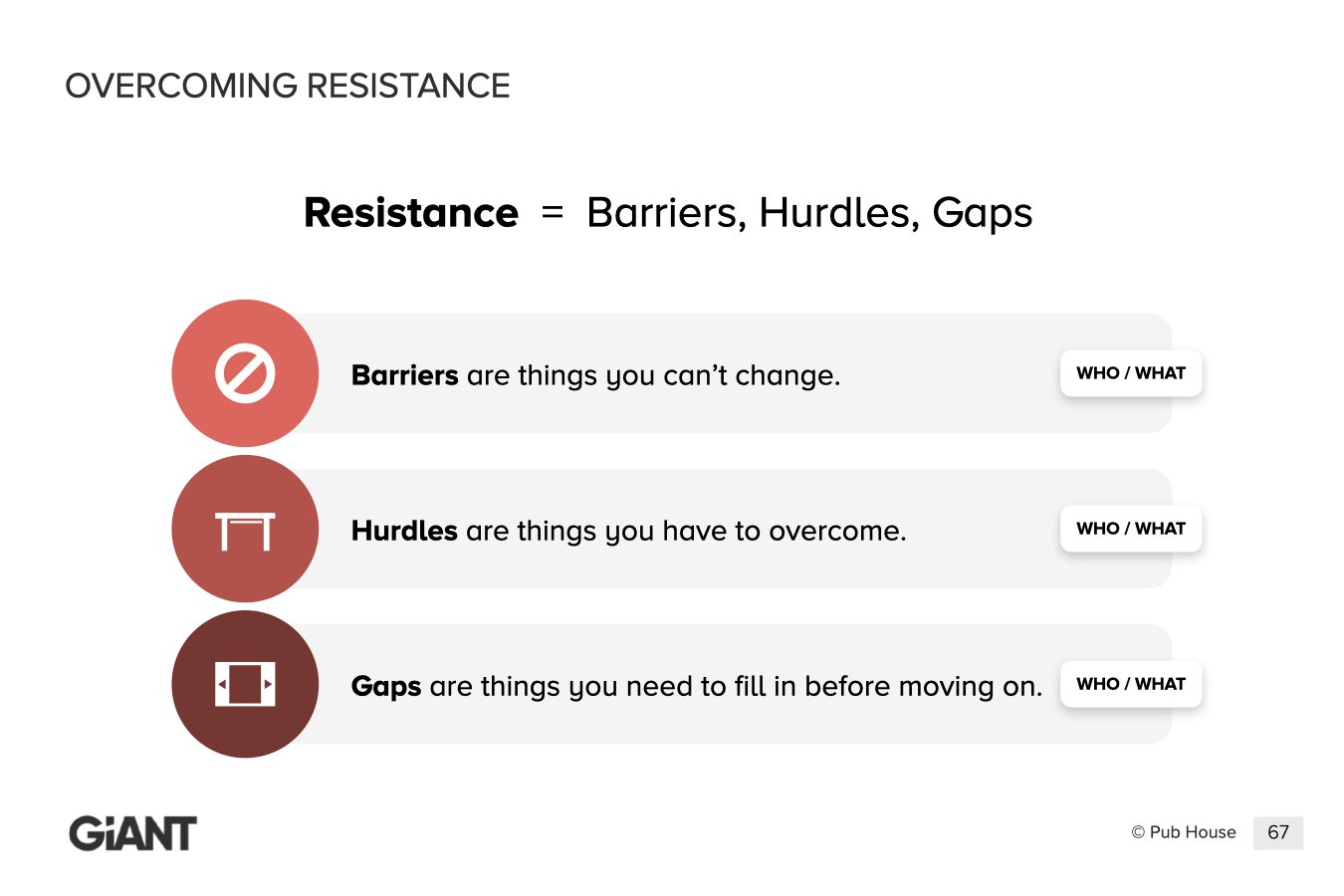
Not all resistance weighs the same, and the mistake most of us make is assuming it does.
Is it a barrier, a hard line he genuinely can't move, a law or a hard stop nobody gets to override? Leadership existing above him is real, but it's not going anywhere, and it's not actually the problem.
Is it a hurdle, then, something that costs real effort but gives way once you push hard enough? That one's tempting, because hurdles feel solvable just by trying harder. But he'd already tried harder, and pushing against people who don't even know there's a line to respect doesn't move anything.
So it's the third option: a gap, something missing that nobody ever put in place. Nobody had ever agreed on which decisions were his to make and which leadership had a real say in. Not a flaw in anyone's character. Just a line that had never been drawn, so leadership kept stepping over it.
That's exactly why we teach this framework to the teams we work with. Once people have a shared language for naming what's actually in their way, the conversation changes, from arguing over whose fault it is to figuring out what to do next.
Why This Matters Now
Misdiagnosing resistance is expensive. Call a gap a barrier and you sit around waiting for someone to change who they are, when all that's actually missing is a conversation nobody's had yet. Call a hurdle a barrier and you quit on something you genuinely had the ability to clear.
Get the diagnosis wrong long enough, and the cost isn't just one stalled project. It's a leader who quietly checks out, or a team that stops trusting that anything is ever going to change.
The Result
When you correctly identify your resistance, you stop wasting energy fighting the wrong fight. A team that knows the difference between a barrier, a hurdle and a gap doesn't fold the first time something gets hard, and it doesn't burn itself out trying to force change on something that was never going to move.
It works around what it can't change, puts in the effort on what it can and builds what's missing instead of waiting for it to appear.
Take Action
Pick one thing standing in your way right now and ask: is this a barrier, a hurdle or a gap? Write down which one it is and who or what it involves.
If you want help sorting out which kind of resistance you're actually facing, let's grab time on the calendar and work through it together.
Closing the Loop
The manager I'm coaching is looking for the right opening to bring this to leadership, to propose the protocol that's actually missing. I don't know yet when that conversation happens or how it'll land. But for the first time in months, he's not waiting around for leadership to change who they are. He's looking for the chance to fill in the gap that was there the whole time.