Should I Call In the Team Yet?
Welcome to another Toolkit Tuesday! Every week, our goal is to give you a practical leadership tool to put in your toolkit.
So There I Was . . .
…standing in a planning room with a brand new warning order while my commander asked if I wanted him to call in the rest of the planning cell.
I had just been selected as a Flight Lead Candidate in the 160th, and this was my first mission in that seat. When a mission drops, that room fills up and gets loud and busy fast, so the expected answer was yes. I told him no, not yet. We had our standard 96 hours to plan, and I wanted a couple of those hours alone at the whiteboard first. I said it without hesitating. I'd been mentored by the best Flight Leads, and I knew how I worked best. He just said, "Sounds good." No second-guessing. He trusted me, and it showed.
Then it was just me, a blank whiteboard and my laptop on a table next to me. On one side of the board I drew a triangle for where we were. Twelve feet away, on the other side, I drew a triangle for our objective. Between those two symbols sat about 1,000 miles, two targets and a lot of unknowns. This was the part of the job I loved most. The closest thing I can compare it to is what I imagine a composer feels at the start of a score for a full orchestra, working out where every instrument comes in before anyone plays a note.
Two hours later I had a base plan on the board, a trash can full of shop towels from erasing and a couple of dead markers. I didn't have every answer, and I didn't expect to. But that base plan, with some modifications, is the one we ultimately went with. I called my XO, the person who keeps the planning cell running, and told him we had a mission. Thirty minutes later I walked him through what was on the board, and he put the team to work.
I could have called everyone in right away. Either they'd have sat around for hours drinking coffee, telling jokes and wondering what was going on, or I'd have handed them the little I knew and watched chaos take over. Questions I didn't have answers for yet. Work that would end up in the trash because it was duplicated, unnecessary or just bad. We probably still would have gotten the mission done. But it would have cost us in frustration, conflict and wasted effort.
The Challenge
Quick update from two weeks ago: our client took the landmark idea and runs with it now. They pass a gas station on the way home, and that's their cue to leave work in the car. It's working.
This week's problem is the other side of that coin. When a big problem lands on a leader's desk, most of us do the opposite of what I did in that planning room. We call the meeting right away, because getting everyone in the room feels like we're doing something. But we walk in with half a picture, and the team spends the next hour asking questions we can't answer yet or racing off to build things we'll throw away next week.
Or we never make the time at all. The inbox is full, the calendar is stacked and thinking ahead feels like a luxury. So we stay busy, and the team stays busy, and nobody is quite sure where we're all headed.
The Tool: 5 Gears

Those two hours at the whiteboard were 5th gear. We've covered the full 5 Gears framework before (read it here), so this week we're zooming in on just one.
5th gear is focus mode. No phone, no inbox, no interruptions, fully locked in on one problem. It isn't measured in hours. Sometimes I got five hours. Sometimes I got five minutes. What mattered was that the time was protected.
Compare that to what happened once the XO brought the team in. The timeflow, the weather brief, the maps with the route, the packets, the data cards for the aircraft and three-way verification of every coordinate, altitude, frequency, fuel load, weight and time. That's 4th gear, task mode, and a mission can't happen without it. But 4th gear only moves you forward when somebody has already figured out where forward is. 5th gear is what makes your team's 4th gear count.
It also gives you language your team can trust. "I need an hour in 5th before I bring you in" doesn't sound like you're shutting people out. It tells them you're doing the work that will make their work worth doing.
Why This Matters Now
Skip 5th gear and your team pays for it. They burn hours on rework, duplicate each other's efforts and argue over a plan nobody actually made. Nobody calls it a leadership problem. It just feels like a frustrating week, and then another one.
And it's late October. Most of us are about to plan 2027 in between year-end deadlines and holiday schedules. If that plan gets built in 4th gear, one rushed meeting at a time, you'll spend next year living with it.
The Result
Let me be clear about something. That mission wasn't a success because of two hours at a whiteboard. It was a success because I had the best team in the world. The XO, the pilots and the crews did the hard work and did it with excellence. My job in those two hours was to give them a foundation worth building on.
That's the real payoff of 5th gear. It isn't about the leader being the smartest person in the room. It's about making sure a great team doesn't waste its talent on guesswork. When you get that right, your people spend their time doing the work instead of trying to figure out what the work is.
Take Action
Draw your two triangles. The next time a big problem lands, before you call the meeting, block 30 minutes alone. Write down where you are, where you need to be and what's in between. Then bring your team in.
Plan it together. If you want help building 5th gear time into your week or your team's rhythm, let's grab time on the calendar and work through it together.
Closing the Loop
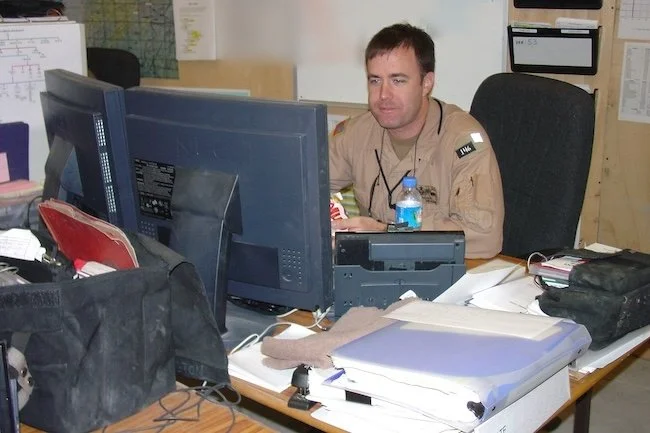
At the Flight Lead planning desk in Afghanistan. Same whiteboard habit, a lot less time.
I went on to pass my Flight Lead ride and complete eight combat deployments. Those 96 hours didn't last. As the war went on, planning time kept shrinking. Partly because we got better at it, partly because our intel got better and partly because the enemy always gets a vote. They moved often, and we had to move faster.
Some missions gave me five hours at the whiteboard. Some gave me five minutes. Over those deployments I refined the skill of being in the right gear at the right time, because the team was counting on me to give them something worth executing.
You won't always get two hours either. But if you assume there's never time for focused work, you're failing your team and maybe your clients too. Don't be that leader.
When was the last time you drew your two triangles before calling the meeting?