I Have No Clue How to Multiply
Welcome to another Toolkit Tuesday! Every week, our goal is to give you a practical leadership tool to put in your toolkit.
So There I Was . . .
So there I was, sitting with a leader who rated himself a 75. Solidly positive, the kind of guy people like being around, generally healthy, generally helpful when someone came to him with a problem. Then he said something I hear more than I'd like to admit: "I could probably get myself to 80 plus. I just don't know how to actually pass any of that on to my people. Would you help me?"
I sat with that for a second, because it wasn't the question I expected. A lot of the leaders I talk to are still working on the first number, still trying to get themselves healthy enough to lead well. This guy had already done a version of that work. He was steady. He was positive. What he didn't know was how to stop being someone people had to come find, and start being someone who went looking for ways to add to others before they ever asked.
Plenty of the leaders we work with are genuinely healthy, people who've put in the real work on themselves, and they still don't know how to hand any of that off to the people around them. They know how to be positive. They don't know how to be intentional.
I didn't have a quick answer for him that day either.
The Challenge
We do this constantly: get ourselves to a good place and then treat that as the finish line. Getting healthy is real work, and it matters. But once you're steady, once you're positive, once you're the kind of leader people speak well of, it's easy to assume you're already giving your team what they need.
You're probably not. Not because you're a bad leader, but because being healthy and knowing how to extend that health to others are two different skills, and almost nobody teaches the second one. My guy at 75 wasn't broken. He was doing what most healthy leaders do: waiting. Waiting for someone to knock on his door, bring him a problem, ask for the help he was fully capable of giving. That's not nothing. But it puts the whole thing on other people to initiate.
The real gap isn't health. It's intentionality. And until you can tell the difference, you can spend years feeling good about how far you've come while your team quietly gets less of you than they actually need.
The Tool: The 100X Indicator
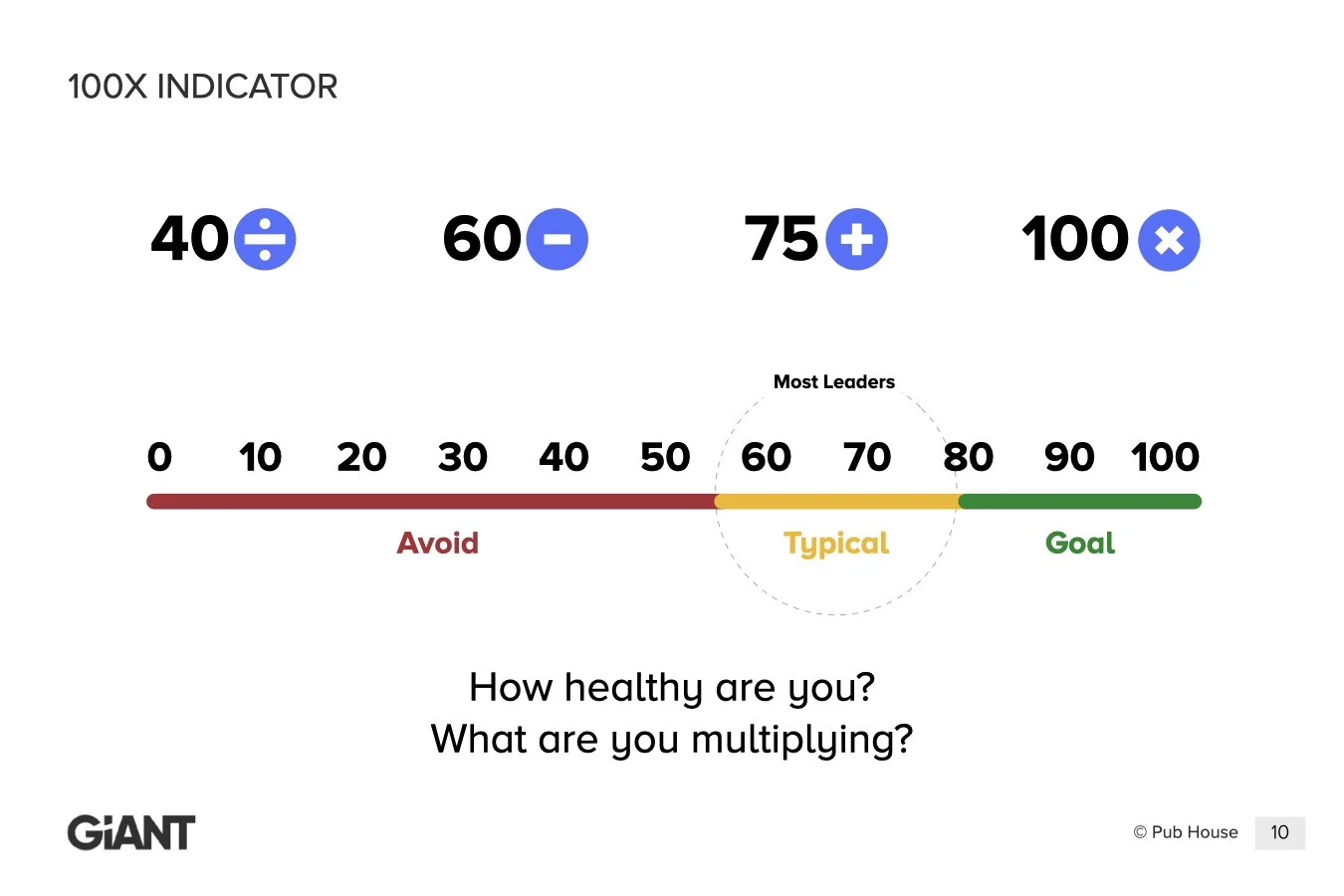
The 100X Indicator asks two separate questions, and most leaders have only ever really answered one of them.
The first is "How healthy are you?" Rate yourself 1 to 100, and be honest about all of it, not just physical health, but emotional, mental, the whole picture of how you're actually doing. Most leaders land somewhere between 55 and 80. Above that is the goal. Below 55 is where you need to stop and deal with yourself before you try to lead anyone else.
The second question is the one that trips people up: "What are you multiplying?" Not what are you doing. What are you multiplying, into the people around you. There are four answers, and they're worth ruling out one at a time instead of jumping straight to the flattering one.
At the bottom is divide. That's the leader who's actually toxic, who creates division wherever they go, usually because of something unresolved in their own life. That wasn't my guy. Above that is subtract, the leader who's frustrated and checked out enough that being around them costs people something. That wasn't him either.
He was add. Positive, approachable, genuinely helpful whenever someone came to him. But add is reactive. It waits for someone to knock. The top of the scale is multiply, where a leader stops waiting and starts proactively looking for ways to build other people up, whether they asked for it or not.
That's the gap he was naming without having the language for it. He didn't need to raise his health score. He needed to move from add to multiply, from reactive to intentional. Once you can name where you actually are on both scales, and where the leader across the table from you is too, you stop guessing at what's wrong and start having a real conversation about it.
Why This Matters Now
A leader stuck at add isn't dragging the team down, and that's exactly what makes it easy to miss. Everything looks fine. People like him. The culture isn't toxic. Nobody's complaining. But a team led by someone who only responds when asked will only ever grow as fast as the people brave enough, or aware enough, to come ask for it. The ones who don't know they need help, or don't feel safe bringing it, just quietly stay stuck.
That's the cost nobody notices until years later: a team that should have grown three or four strong leaders out of itself only ever produced one.
The Result
A leader who makes the shift from add to multiply changes what the whole team is capable of. People who used to wait to be noticed start getting developed on purpose. The next generation of leaders inside the organization stops depending on luck, on who happened to be confident enough to ask, and starts happening by design.
Stay at add, and you'll keep getting credit for being a good leader, because you are one. But the growth stops with you. Move to multiply, and it doesn't.
Take Action
Rate yourself honestly on both parts of the indicator this week. Where do you land on the health scale, and which of the four, divide, subtract, add or multiply, actually describes what you're giving the people around you? Then pick one person on your team who hasn't asked you for anything lately, and go find them anyway.
If you want help figuring out where you actually stand and what would move you from add to multiply, let's grab time on the calendar and work through it together:
Closing the Loop
That conversation didn't end with him "fixed". It ended with us still meeting, and now that he has a name for what he was missing, we're working through the actual tools for how you become a multiplier, not just knowing that you're not one yet. He's still working to become the healthiest version of himself he can be, but now he's doing that alongside learning how to multiply, how to go find the people who haven't come to him yet, before they ever do.
That shift doesn't show up on a scorecard right away. It takes reps. It takes intentionality that shows up over weeks and months, not in one good day. But it's the difference between a leader who's well liked and a leader who actually multiplies himself into everyone he touches, and most of us don't find out which one we are until somebody asks us the same question he asked me.