
The Star Next to My Coffee Order
Welcome to another Toolkit Tuesday! Every week, our goal is to give you a practical leadership tool to put in your toolkit.
So There I Was . . .
I was in Missouri this summer, visiting family, and we needed coffee and food for everybody. My daughter Emma came with me, and I pulled up the Starbucks app and put in an order for the whole family, ten drinks and a sandwich, then walked in to wait for the board to update.
That board is nothing special. Names pop up as orders come in, move from "in progress" to "ready." I've watched that screen in a hundred different Starbucks in a hundred different cities. But this time, next to my name, there was a star.
I had no idea what it meant, so I asked. Turns out it marks you as a Reserve member, someone who's spent enough with Starbucks that the app flags your account and tells the store before you ever get to the counter. I'd never been in that store before. Nobody behind the counter had ever seen me before. And somehow they already knew something about me that made them treat my order a little differently.
It's a small thing. A star on a screen. Emma even asked me about it. But I stood there doing the math on what it actually took to make that happen, and the answer was: not much. No conversation, no gift, no grand gesture. Just a system that noticed I mattered to them and quietly let the people in front of me know it.
The Challenge
Most of us think of support as the big stuff. A raise. A promotion. A day off when things are rough. Those things matter, but they're rare, and they take planning. The kind of support that actually keeps people engaged is smaller and more frequent than that, and it's the kind we skip because we assume people already know how we feel about them.
That assumption is the problem. As a leader, you carry the full picture in your head all the time, how much you value someone, how much you'd notice if they were gone, how much of what you've built depends on them. Your people don't have access to that picture. All they have is what you actually show them. And if the only thing you consistently show them is the next ask, the next deadline, the next thing that needs fixing, that's the story they'll believe about how much they matter to you.
This isn't just a big team problem either. It doesn't matter if you're leading two hundred people or working shoulder to shoulder with one business partner. The gap between what's in your head and what you actually communicate is the same gap, and it shows up the same way.
The Tool: Support Challenge Matrix
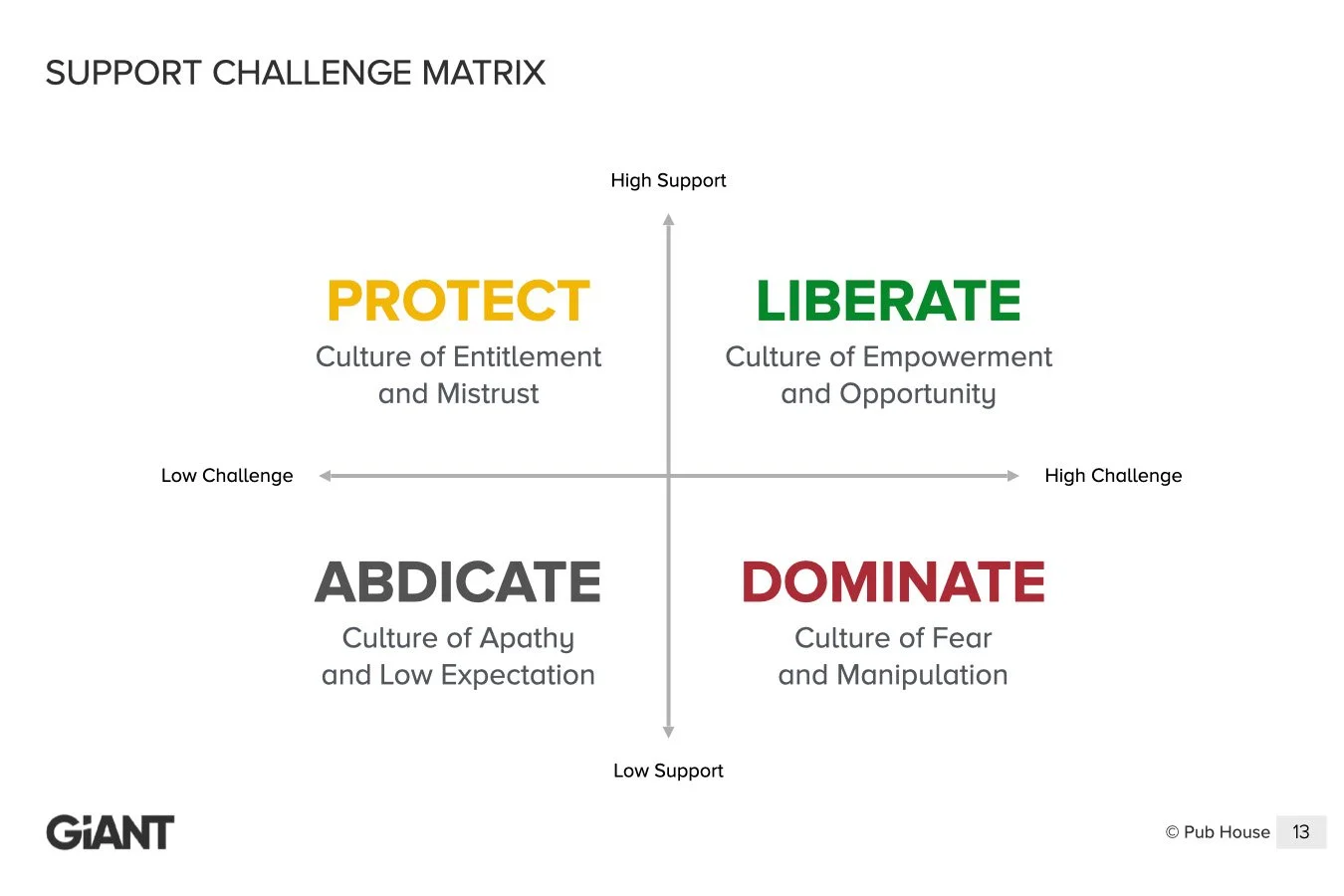
We've walked through the full matrix before, if you want the refresher on all four quadrants, we broke it down here: Calibrating Support & Challenge. Today I just want to zoom in on one side of it: support.
If you're wired like a Pioneer or a Guardian, support is the muscle you don't reach for naturally. Pioneers are wired to push, move fast and challenge people to keep up. Guardians are wired to hold the standard and challenge people to meet it. Both voices default to challenge without even trying. Support doesn't come with the wiring. It has to be built in on purpose.
That's what the star on the Starbucks screen actually was. Not a grand gesture, just a small, deliberate signal that said I see you, sent on purpose. If support isn't your instinct, that's fine, it doesn't have to be. It just has to be something you build into how you lead, the same way you'd build in a metric or a deadline. Pick one person. Do one specific, deliberate thing that tells them you see them. That's the whole practice.
Why This Matters Now
If you never say it out loud, your people will fill in the blank themselves, and they usually fill it in worse than the truth. Someone who never hears they matter starts to assume they don't, no matter how good their numbers look or how long they've been with you. That belief doesn't show up as a complaint. It shows up as someone quietly disengaging, then quietly leaving, and you find out how much they mattered right when you lose them.
The Result
Leaders who build small, deliberate support into how they lead get a different kind of team. People take more ownership because they're not just executing, they're invested. They bring you problems earlier instead of hiding them, because they trust you're for them, not just watching them. Leaders who skip this and lean only on challenge get compliance for a while, right up until they don't.
Take Action
This week, do one specific thing that tells someone on your team you see them, not a general gesture, one deliberate action aimed at one person. Then let's talk about where you're actually landing on the matrix and what it would take to move toward Liberate.
Closing the Loop
I still don't know exactly what earned me that star. Some algorithm somewhere decided I'd spent enough, ordered enough, shown up enough, to be worth flagging. A coffee company built a system to make sure I felt that, in a town I don't even live in. I keep thinking about how that's a low bar, and how often I still don't clear it for the people who actually matter to me.
