The Question I Couldn't Answer
Welcome to another Toolkit Tuesday! Every week, our goal is to give you a practical leadership tool to put in your toolkit.
So There I Was . . .
I live in the present. That's where I do my best work, today's client call, the task right in front of me, the fire that needs putting out. Long term thinking, the what ifs, the five year plans, all of that drains me, even though I know it matters. So about a month ago, when my days started running together, I didn't think much of it. I was getting things done. Client meetings, lead gen, keeping the business moving. None of it felt different from the day before.
Then I was in a meeting with two of the top leaders at a company we coach. We got into strategy, and one of them said something that stopped me. They had never really answered why they were doing this in the first place. When they started the business, the answer was simple. Make more money. That answer had carried them for a while. It had stopped carrying them.
I could feel it in the room. Two people who had built something real, sitting there without a strong enough reason to keep carrying the weight of it.
And then it hit me. Me too.
I had been so buried in the week to week at Khaki Consulting, the client work, the lead generation, the next task on the list, that I had lost sight of why we were doing any of it. I was sitting across from two leaders asking a question I could not have answered for myself with any real confidence.
The Challenge
It is easy to run a business, or lead inside one, without ever revisiting why it exists. You can be busy. You can hit your numbers. You can show up to every meeting and check off every task, and still be operating on autopilot because the actual reason behind the work faded into the background months or years ago.
For a lot of leaders, the original why was simple. Grow it. Make more money. Build something. That is not a bad starting point, but it rarely holds up on its own once the business matures. When the only answer left is the paycheck, the work stops meaning anything beyond the transaction, and the days start blurring together even when everything looks fine from the outside.
That is the trap. It does not usually show up as a crisis. It shows up as sameness, as competence without energy behind it. Most leaders do not notice it is happening to them until someone else's version of the same problem forces them to look.
The Tool: Peace Index
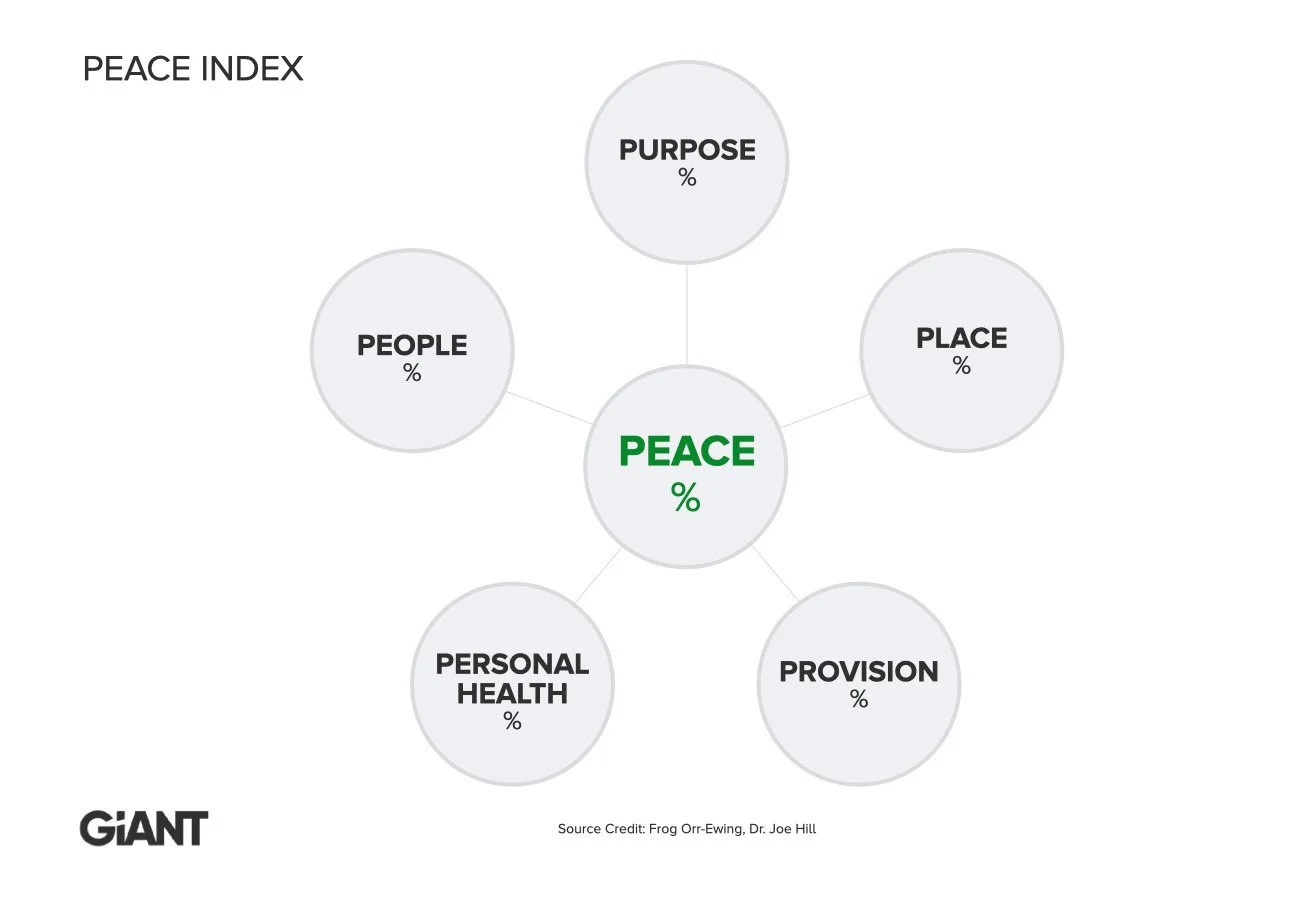
What I felt in that meeting, and what those two leaders were sitting in, has a name. In the Peace Index, it is Purpose, one of the five areas the tool measures alongside People, Place, Provision and Personal Health. We have walked through the full framework before, so if you want the complete breakdown of all five, you can find it here: The Peace Index.
This time I want to zoom in on just Purpose.
Purpose asks a simple question. Is the work you are doing still connected to a reason bigger than the task in front of you? You score it 1 to 10, same as the rest of the Peace Index, with 10 meaning your work and your why are fully lined up, and 1 meaning you could not tell someone why any of it matters if they asked.
Low Purpose does not stop you from being productive. That is what makes it sneaky. You can sit at a 3 or 4 and still close deals, run meetings and keep the lights on. What you lose is the energy underneath the output. High Purpose is different. It gives you something to lock into when a client relationship gets hard, when the business is on cruise control, or when you land a win worth celebrating. It holds steady when circumstances do not.
Naming it this way matters. "I'm just tired" is hard to act on. "My Purpose score is a 4 right now" is not. It gives you, and anyone you lead alongside, a specific place to start the conversation instead of guessing at what is actually wrong.
Why This Matters Now
This is not just a founder problem or a Khaki problem. Any leader who has been running the same operation for a while can lose track of why they started, especially when the metrics still look fine. Revenue does not tell you if your purpose eroded. Neither does a full calendar.
The risk is not that you notice right away. It is that you do not. You keep performing at a level that looks acceptable while running on fumes underneath it, until something, a client's honest comment, a slow quarter, a hard year, forces the question back to the surface. By then it has usually been costing you longer than you realized.
The Result
Answering it gave me relief, then changed how we operate.
I pulled out Six Questions Every Business Owner Should Answer, something my partner and I had finished at the start of the year and left in a drawer for eight months. Reading our own answer again, to unlock the potential of 100,000 leaders, did what a month of metrics never could. My Purpose score went from a 40 to a 90 in one sitting.
The lasting change is our last partner meeting of the month, now three hours built around purpose, mission, vision and strategy instead of just numbers, so it stays in front of us.
Take Action
This week, score your own Purpose 1 to 10, honestly, not the answer that sounds good in a meeting. Then try to write, in one sentence, why your business or your role exists beyond the money. If you cannot finish that sentence without hedging, that is the gap to work on, not the score itself.
If you want help working through it, let's grab time on the calendar and walk through your Peace Index together, starting with Purpose.
Closing the Loop
I still live in the present. That has not changed and it is not going to. But now, when I am in the middle of a week that looks like the one before it, I know why it matters. That is the difference between running a business and just running through one.
The two leaders in that meeting are still working through their answer. I do not know yet where they will land. But I know the version of me sitting across from them a month ago could not have asked the question with any real confidence. The version of me now can.