
What Is Stealing Your Peace?
Welcome to another Toolkit Tuesday! Every week, our goal is to give you a practical leadership tool to put in your toolkit.
So There I Was . . .
So there I was in the back of a CH-46 helicopter, the one with blades on each end.
We had just completed a mission and were flying back to the ship at night. Right into an electrical storm. The pilots could not use night vision goggles. Wind and rain tossed the helicopter constantly.
Most of my teammates were tense. Some were praying. Some were talking fast and loud. Everyone felt the pressure.
Me? I was asleep.
When we landed safely, one of my teammates asked how it was even possible that I could sleep through that.
At the time, I did not have the language for it. But I do now.
The Challenge
Most leaders believe peace is tied to circumstances.
If things calm down, I will feel better.
If this situation gets resolved, I will have peace.
If the pressure goes away, I can lead well again.
That belief quietly creates reactive leadership.
When peace depends on circumstances, clarity disappears under stress. Confidence erodes. Leaders start operating from survival instead of purpose. And teams feel it.
The Tool: The Peace Index
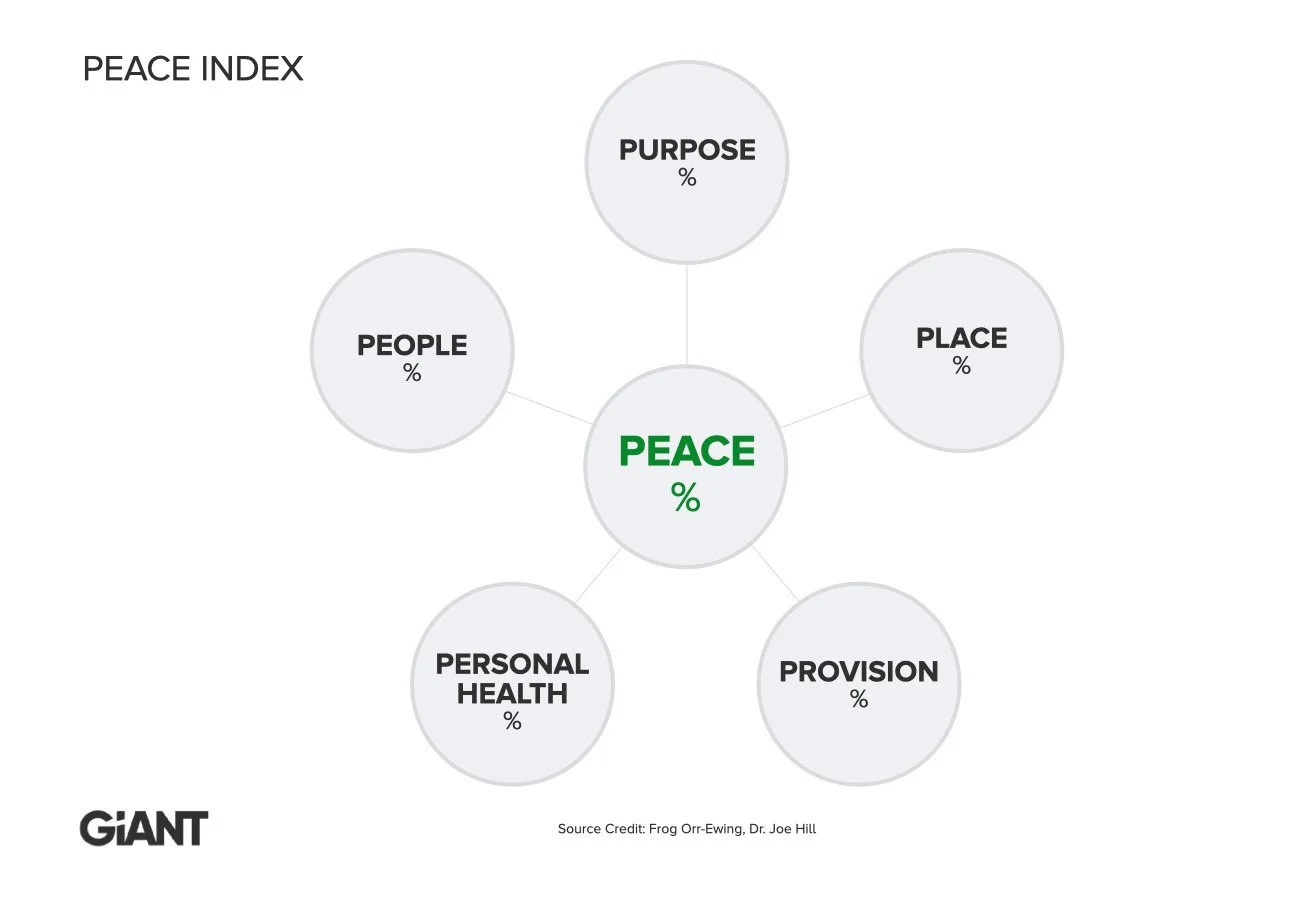
The Peace Index helps you understand how key factors and specific stressors are affecting your peace and, as a result, your health and behavior.
It looks at five core areas:
- Purpose: Are you doing meaningful work that aligns with your values and goals?
- People: Are your relationships healthy, supportive and life giving?
- Place: Does your environment help you thrive or does it quietly add stress?
- Provision: Do you feel financially secure and equipped to meet your needs?
- Personal Health: Are you caring for your physical, mental and spiritual well being?
Give each area a score from 1 to 10, with 10 being fully at peace.
When your Peace Index is high, you tend to think clearly and without distraction. Challenges feel manageable. Leadership flows from a place of confidence, security and humility.
When your Peace Index is low, internal stress consumes energy and focus. Leaders may still perform, but often undermine their own effectiveness and culture along the way.
Why This Matters Now
Leadership pressure is not slowing down.
Expectations are higher. Change is constant. Uncertainty is normal.
And this time of year adds another layer. End of year deadlines, Christmas, New Years, family dynamics and financial pressure all stack up quickly. It is easy to tell yourself you will address peace after the season passes.
But when peace drops, leadership quality drops with it.
If leaders do not intentionally protect peace, the environment will shape them instead. And over time, low peace does not just affect the leader. It affects decision quality, relationships and trust across the team.
The Result
When leaders operate from a high Peace Index, they bring clarity instead of chaos. Teams feel steadiness. People know what matters and where they stand.
When leaders ignore their Peace Index, tension leaks into conversations, decisions and culture. Nothing explodes, but momentum quietly fades.
Peace is not passive. It is foundational.
Take Action
Score your Peace Index honestly this week. Identify the lowest area and name one concrete step to restore peace there instead of powering through.
Schedule a conversation with us to walk through your Peace Index and clarify what is draining your peace and how to lead from a healthier place.
Closing the Loop
That helicopter ride did not change the storm.
It revealed what happens when peace is internal instead of circumstantial.
The leaders people trust most are not the ones who eliminate chaos. They are the ones who stay grounded enough to lead others through it.
Because when leaders carry peace, the people around them can breathe again.
