When New Ideas Cost You
Welcome to another Toolkit Tuesday! Every week, our goal is to give you a practical leadership tool to put in your toolkit.
So There I Was . . .
I was working with a team that had done the hard work. They explored the idea fully and reached the top of the triangle. They moved into simplification, refined the plan, and the implementation team started executing. Hours of prep were already complete when the good idea fairy walked in.
A leader tossed in a new option. Someone else added a contingency. Another voice wanted to adjust something that had already been agreed on.
Within minutes, the team had drifted right back into exploration. The people who were knee deep in implementation felt blindsided and resentful. Others felt like they were just improving the idea. The tension was real because the target moved after the work had already begun.
The Challenge
This is what happens when a team loses clarity about where they are on the Simplicity Triangle. Exploration is wide open and creative. Simplification is focused and disciplined. When you mix them, you get frustration, rework, and wasted energy.
It is even harder when different voices show up in different places. Pioneers and Creatives often stay in exploration longer. Guardians and Nurturers feel the cost of late changes fast. Connectors get caught in the middle trying to hold everyone together.
The Tool: Simplicity Triangle
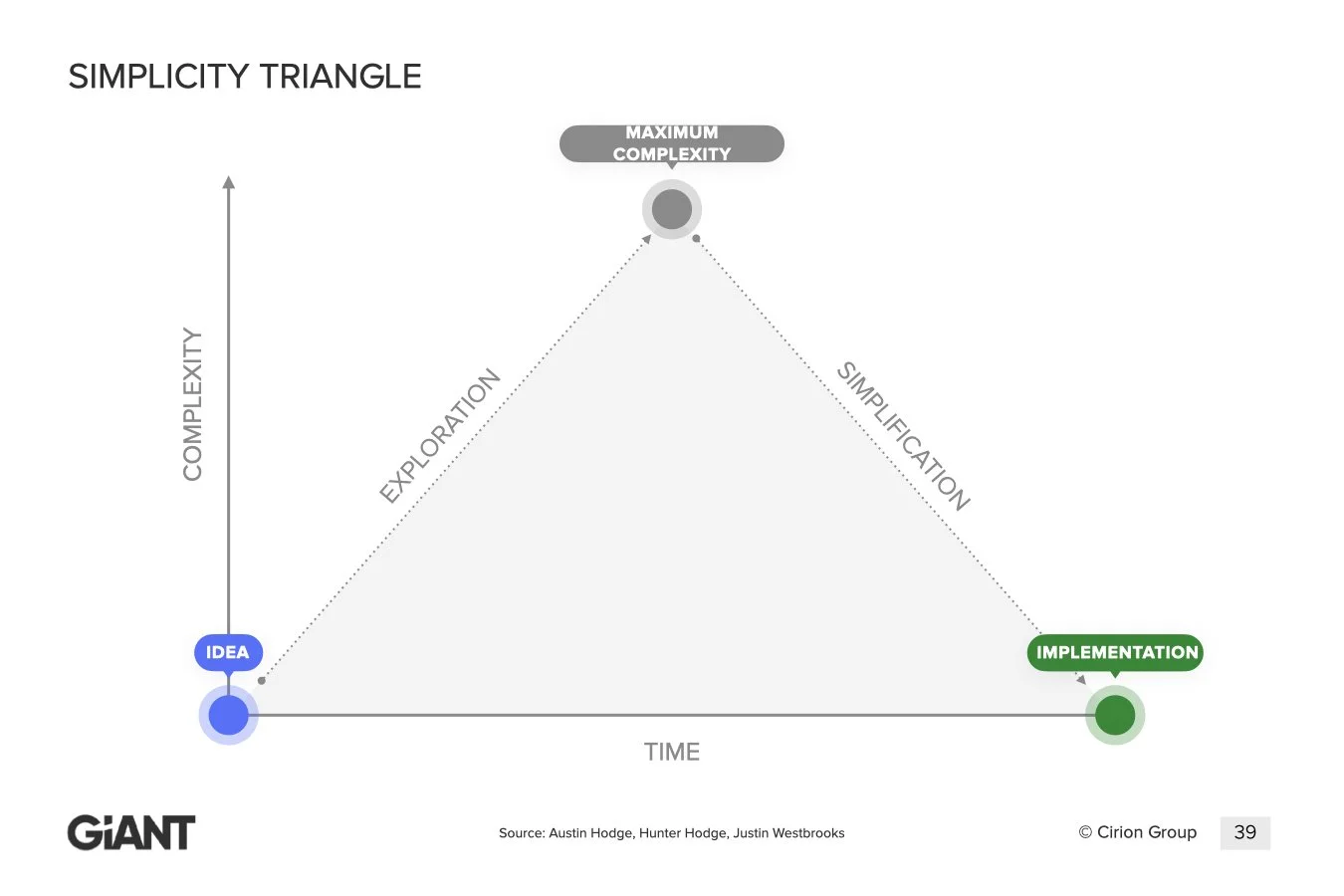
The Simplicity Triangle helps you take an idea from concept to execution by moving through three stages. It starts simple. Exploration expands it. Simplification brings it back down so it can be communicated and implemented.
Every idea goes through this journey. It must get more complex before it can get simple again. Exploration opens possibilities. Simplification brings discipline. If you skip one side or confuse the phases, the work suffers.
The triangle also gives you a shared language. You can pause a meeting and ask, “Where are we right now?” That one question keeps people aligned and reduces frustration.
Why This Matters Now
When teams slide from simplification back into exploration, the cost is real. Hours of work get undone. Timelines stretch. Money gets wasted. Relationships take a hit. The team loses trust because no one knows when the plan will stop changing.
But when the team knows which phase they are in, they collaborate better. Exploration feels fun instead of chaotic. Simplification feels productive instead of restrictive. Ideas get refined, implemented, and scaled with far less friction.
The Result
If you follow the triangle, projects move faster, expectations stay aligned, and the team protects the work already completed. Everyone understands when to dream and when to decide.
If you ignore it, you will see scope creep, resentment, rework, and a constant sense of starting over. Creative voices will feel constrained. Guardian voices will feel ignored. And the business will pay for it in time, morale, and money.
Take Action
Ask your team where they believe you are on the triangle right now. If half the team says exploration and the other half says simplification, you already found the problem. Decide which phase you are in and commit to it.
If you want to get better at using the triangle to speed up execution and reduce rework, schedule a call. We can look at where your team gets stuck and help you move ideas all the way to implementation with clarity and confidence.
Closing the Loop
The team I mentioned earlier realized they were not aligning their voices or their expectations. Once they identified where they were on the triangle, the frustration dropped. They protected the implementation phase, honored the work already done, and moved forward together. The moment everyone understood the process, they were able to stay people focused and get the idea across the finish line.