Before They Quit, Did You Diagnose It?
Welcome to another Toolkit Tuesday! Every week, our goal is to give you a practical leadership tool to put in your toolkit.
So There I Was . . .
I was sitting with a client recently when they told me someone on their team had quit. They walked me through the tension that had been building and the frustration that had surfaced over time. Then they said, “Honestly, it was probably for the best.”
There was relief in their voice. When someone leaves and the relationship has been strained, it can feel like the pressure just lifted.
But I kept thinking about a different question. Before they walked out, did we truly fight for their highest possible good? Did we have the right performance conversations? Did we provide the clarity, coaching and challenge that might have changed the outcome?
The Challenge
Leading people is complex because people are complex.
When performance slips or tension builds, most of us are juggling so many immediate demands that we default to whatever feels easiest. Sometimes that means avoiding a hard conversation. Sometimes it means assuming the issue sits squarely with them.
But if we are serious about developing people, we cannot afford to guess. We need a systematic way to assess performance so we do not miss what we own in the equation.
Without that discipline, we may lose good people not because they lacked potential, but because we lacked clarity or courage.
The Tool: Performance Diagnostic
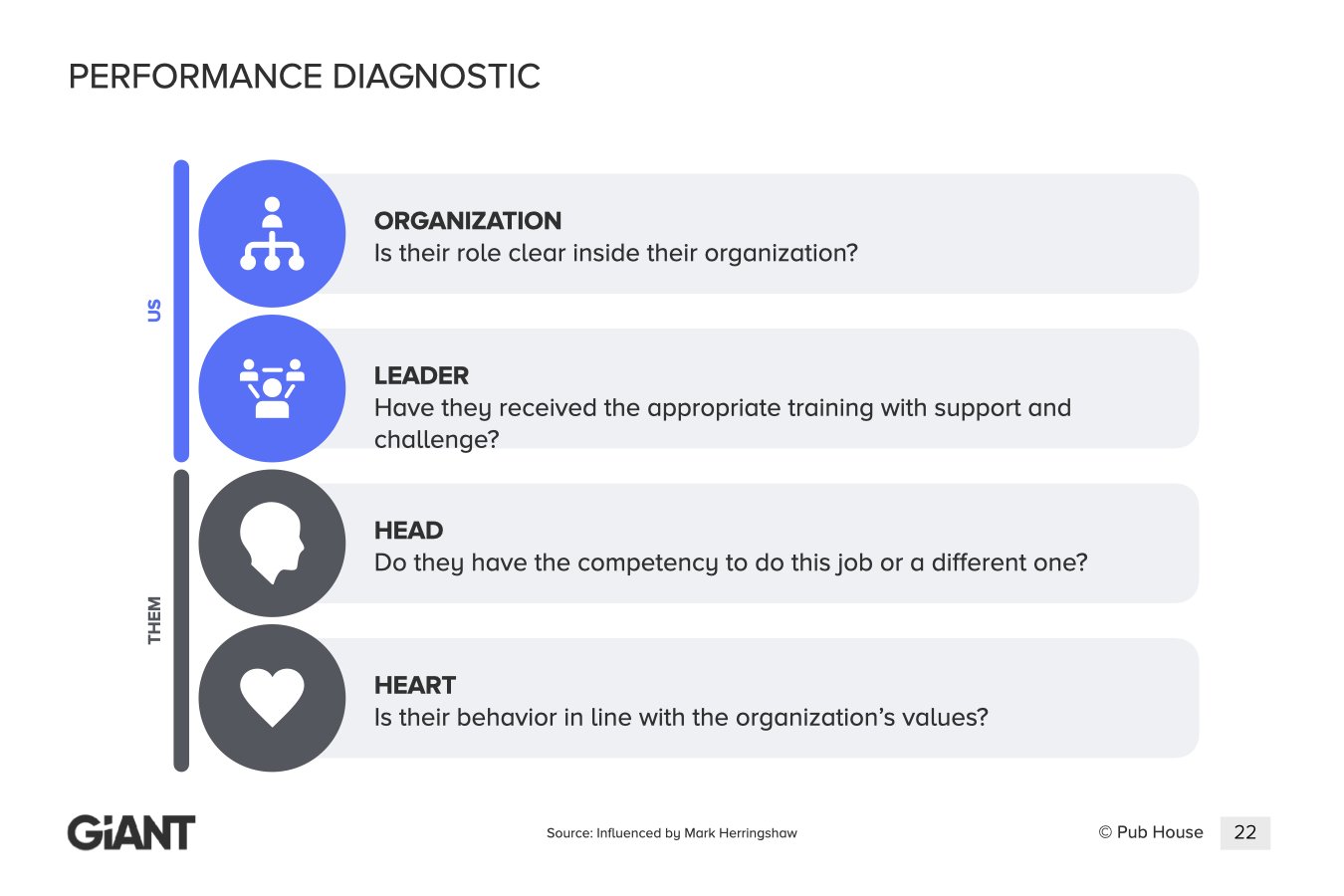
The Performance Diagnostic gives us a structured way to assess performance before jumping to conclusions. It forces us to start with us before moving to them. The top half of the tool is labeled Us. The bottom half is labeled Them. That order matters.
Organization (Us): Is there something in the organizational structure or culture contributing to the issue? Was the role clearly defined? Were expectations explicit? Did we create an environment where success was clearly understood?
Leader (Us): Have I provided the right training, coaching and feedback? Have I clearly communicated what growth looks like? Did I offer support and challenge in a timely way, or did I delay the hard conversation?
Head (Them): Do they have the competency required for this role? Is this a capability issue or possibly a fit issue? Would they thrive in a different seat where their strengths are better aligned?
Heart (Them): Are motivation, attitude or values misaligned? Do they genuinely want to do this work? This is the most sensitive layer and requires open dialogue, not assumption.
When we are thorough in the Us categories first, we build credibility. We earn the right to challenge at the Head and Heart level because we have already owned what is ours.
Why This Matters Now
Turnover is expensive. Vacancies create pressure. Hiring and onboarding take time. Institutional knowledge walks out the door when someone leaves.
But there is a deeper cost. When leaders consistently skip diagnosis and avoid clear performance conversations, a culture of ambiguity forms. Expectations blur. Feedback feels reactive instead of developmental.
Using this framework protects more than productivity. It protects your people from being mismanaged.
The Result
When you use the Performance Diagnostic consistently, you make fewer reactive decisions. You have clearer conversations. You address issues earlier instead of waiting until frustration builds.
Sometimes the outcome will still be a transition. Not everyone is meant for every role.
But when someone does move on, you will know you led them well. You will know you fought for their growth before accepting their exit.
That posture changes the way your team experiences your leadership.
Take Action
Choose one current performance concern and walk it through the Performance Diagnostic in writing. Own what sits under Organization and Leader, then schedule the conversation.
If you want to build a culture of clear and growth focused performance conversations, schedule a call with us. We will help you implement the framework well.
Closing the Loop
That client did not need to feel guilt about the person who quit. But they did leave with a renewed commitment.
Next time tension rises, they will not settle for relief. They will slow down, diagnose and engage the hard conversation earlier.
Because strong leadership is not about holding on to everyone.
It is about knowing you fought for the highest possible good of the people entrusted to you.