What Story Are You Filling the Gap With?
Welcome to another Toolkit Tuesday! Every week, our goal is to give you a practical leadership tool to put in your toolkit.
So There I Was . . .
A friend of mine received an email from his boss asking him to stop by the office at the end of the day. There was no context. Just a quick message asking him to come in before he left for the day.
When he got there his boss told him they needed to talk about a communication issue. Apparently several people on the team had raised concerns with HR about the tone of his emails. The feedback was that his messages felt cold and a little abrupt. He tended to jump straight into the topic without opening with something cordial or relational.
My friend sat there a little confused. From his perspective he was not upset with anyone. He was not frustrated with the team. He was simply communicating clearly and getting to the point of what needed to happen next.
But by the time he sat in that office the story about his intentions had already been written.
The Challenge
This is something leaders see all the time.
Someone observes a behavior. An email that feels short. A deadline that slips. A quiet teammate in a meeting. A handoff that does not go the way someone expected.
Instead of asking a question to understand what happened, we fill in the meaning ourselves. The gap between what we expected and what actually happened gets filled with a story.
And if we are honest, the story we create is rarely generous.
The Tool: Mind the Gap
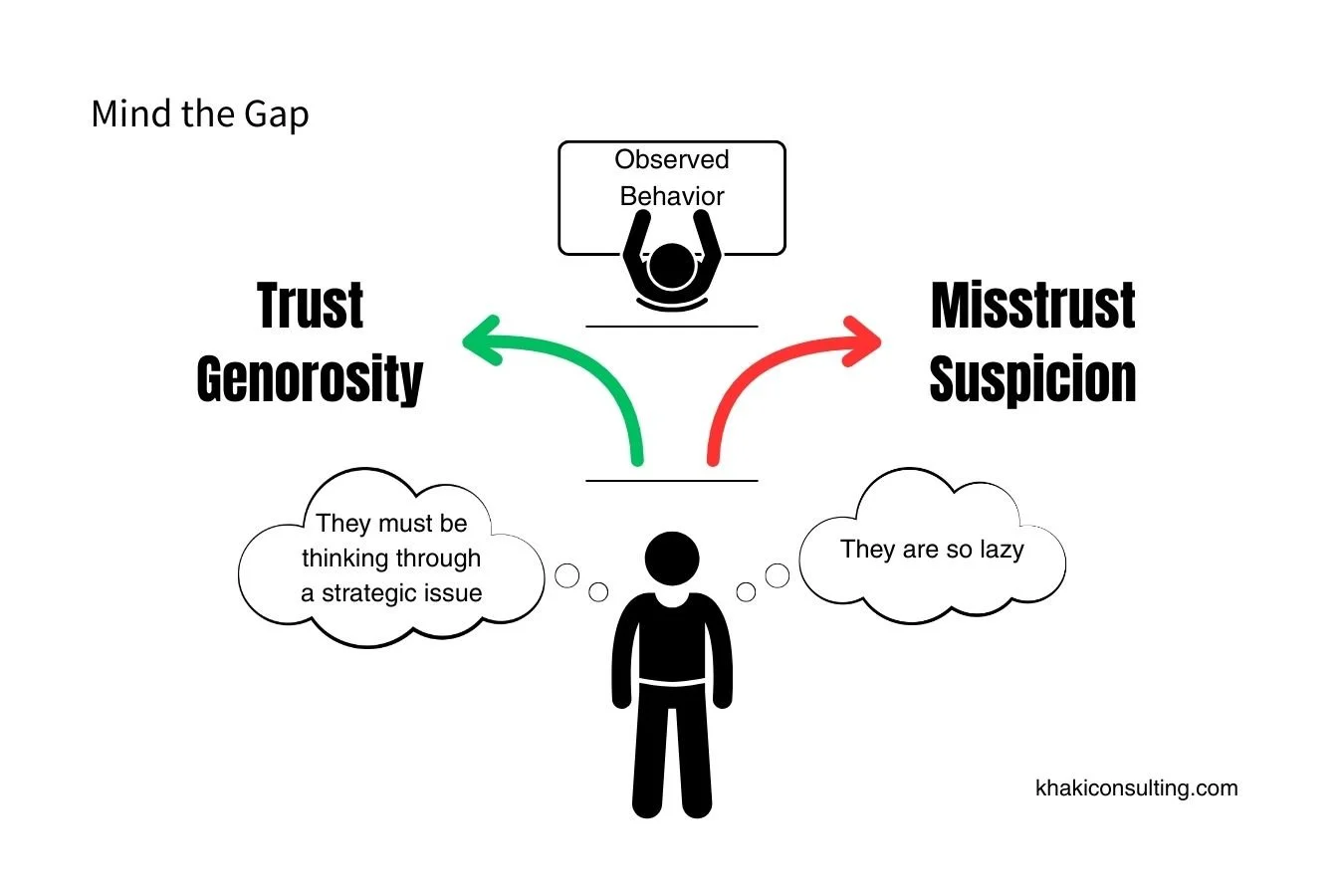
The tool is simple. When you observe a behavior, pause before assigning meaning to it.
There is always a gap between expectation and execution. Something was expected and something else happened instead. In that space between the two we naturally begin creating explanations for why.
Leaders can fill that gap with mistrust and suspicion. They assume someone did not care, dropped the ball or was frustrated with the team. Once that story forms, it starts shaping how people interpret every future interaction.
Or leaders can fill the gap with trust and generosity. They assume there may be something they do not yet understand. Instead of deciding what the behavior means, they choose to ask a question first.
The behavior may be the same in both cases. The difference is the story we attach to it.
Why This Matters Now
Most frustration at work lives in the gap between expectation and execution.
Deadlines slip and no one talks about it. Work gets handed off between teams and assumptions are made about who owns the next step. Priorities are interpreted differently across departments. Communication happens after the fact instead of before the work moves forward.
When leaders fill those gaps with assumptions instead of curiosity, small misunderstandings turn into bigger problems. Trust slowly erodes because people begin reacting to the story instead of the situation.
Many times the real issue is not attitude or effort. It is unclear expectations, competing priorities or simple miscommunication that no one stopped to address.
The Result
When leaders learn to mind the gap, something important changes in the way teams operate.
Instead of reacting to assumptions, leaders start asking better questions. Conversations happen earlier instead of after frustration has already built up. Expectations become clearer and people feel safer explaining what is actually going on.
Over time this strengthens trust across the team because people know they will be asked for context before they are judged.
When leaders ignore the gap the opposite tends to happen. Small behaviors get interpreted as character issues. People begin managing perceptions instead of solving problems. The team slowly loses trust because assumptions replace conversations.
And most of the time the original story we told ourselves was not even true.
Take Action
Think about the last time someone on your team frustrated you. Before deciding what their behavior meant, pause and ask one clarifying question to better understand what actually happened.
If you want help creating clearer expectations and stronger communication inside your team, schedule a conversation with us. Many leadership challenges are simply gaps between expectation and execution that have never been addressed.
Closing the Loop
My friend left that meeting still trying to make sense of it. From his perspective he had simply been communicating clearly about the work.
From everyone else’s perspective his tone meant something very different.
The gap between those two perspectives had already been filled with assumptions.
Great leaders learn to slow down long enough to ask a question before they decide what a behavior means. Because most of the time the real issue is not the person. It is the story we told ourselves in the gap.