The Org Chart He Threw Away
Welcome to another Toolkit Tuesday! Every week, our goal is to give you a practical leadership tool to put in your toolkit.
So There I Was . . .
A friend of mine and I grabbed coffee last week, and he was still shaking his head about an all hands meeting his company had just held. It's a startup, well funded, growing fast, the kind of place that moves at a pace most companies would find terrifying. He told me the CEO opened the meeting with a slide of a traditional org chart, the neat boxes and lines everyone's seen a hundred times, and called it outdated. Said it couldn't keep up with how fast they needed to move, that it choked out new ideas.
Then he clicked to the next slide. A honeycomb. Dozens of hexagons, all connected, no top, no bottom. He explained that each honeycomb was a department, and everyone's job was simply to produce honey and move around to wherever the work needed them.
My friend said the room went quiet in that specific way rooms go quiet when nobody wants to be the first to ask the obvious question. Eventually somebody did. So who's my boss? The answer was it depends. What are my goals this quarter? Also depends. What does winning look like for my team? Nobody could really say.
The Challenge
Here's what got me. This CEO isn't dumb. He's a sharp, genuinely talented founder who's built something investors want to fund. He wasn't trying to confuse anyone. My guess is he was trying to be clever, to look different from every other startup running the same tired boxes and lines, a structure that signaled speed and flexibility instead of hierarchy and bureaucracy.
But that's exactly where it went wrong. He skipped the one thing that makes any structure work at all, whatever shape it takes. People need to know where they stand. Who they answer to, what's actually theirs to own and how anyone would know if they're doing a good job. Take that away and it doesn't matter how clever the metaphor is. Clever didn't buy him speed or flexibility. It bought him chaos. You haven't freed people up. You've just made them responsible for guessing.
That's the part that gets missed when leaders reach for reinvention. Confusion isn't a minor side effect while everyone adjusts. It's an immediate cost. People stop making decisions because they're not sure it's theirs to make. They start over explaining themselves in every conversation because nobody's sure who needs to know what. And the ones who feel it most are usually your best people, the ones who actually want to do good work and can't find the lane to do it in.
The Tool: Role Clarity
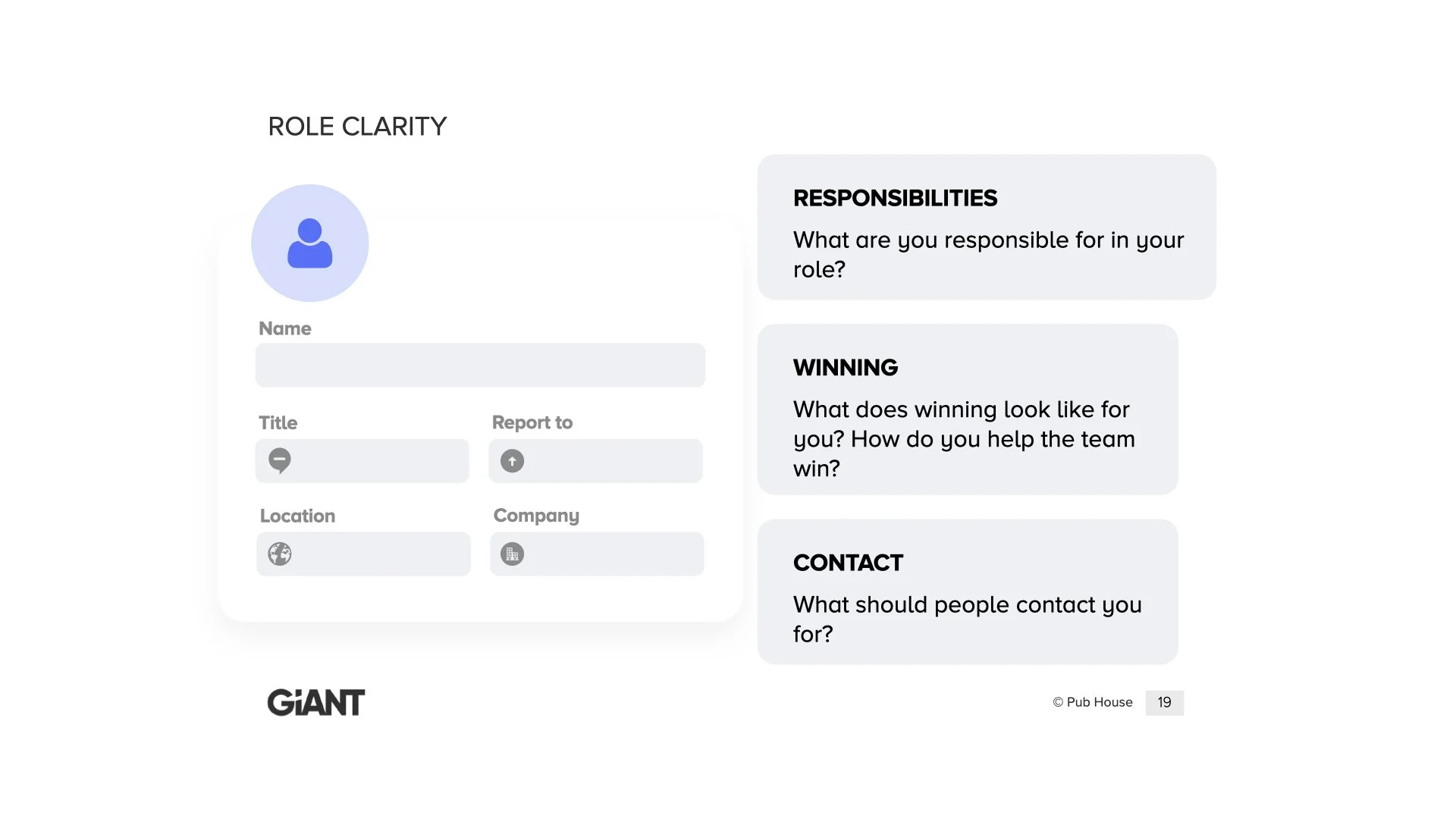
This is exactly the kind of moment the Role Clarity tool exists for, and it's about as simple as leadership tools get.
Start with the basics. What is this person's role, and who do they report to. No ambiguity, no it depends. Then name their actual responsibilities. Not a vague description pulled from a job posting, but specific ownership. What is genuinely theirs to decide and carry.
Next, define what winning looks like. How would they know, without asking anyone, that they're doing well. Then connect it upward. How does their role move the team and the company forward, and who can come to them when they need what only that person can provide.
Four questions. You could ask them of every person in that all hands meeting in about ten minutes each and you'd fix more real confusion than any slide about honeycombs ever could.
What changes once a team actually has this language is the conversation they get to have. A complaint like nobody knows what's going on turns into something specific. This isn't a role problem, it's a responsibility problem. Or, we agree on the role, we just never agreed on what winning looks like. That's a very different conversation than guessing at what a wall of honeycombs was supposed to mean.
Why This Matters Now
Speed is the whole reason a leader like this reaches for something new in the first place. He wants people moving fast and thinking big instead of waiting for permission. Fair goal. But confusion doesn't create speed. It creates hesitation dressed up as flexibility.
When nobody's sure what's theirs, decisions slow down because people are scared to step on each other. Good ideas die in the gap between departments because nobody owns the follow through. And the leaders who could actually execute the vision spend their energy trying to figure out the rules instead of doing the work.
The Result
Left alone, this costs a company exactly what my friend is watching happen right now. Good people start quietly looking elsewhere, because uncertainty about your own role is exhausting in a way that's hard to explain to anyone outside it. Momentum slows even though everyone's still busy. And if you're an investor watching a leadership team change the org structure every few months chasing the next big idea, you start wondering if the money's funding a vision or funding chaos.
Fix it, and you get the opposite. People move fast because they know exactly what's theirs, not because nobody's watching. Ownership goes up. The best people stay, because clarity is one of the few things that actually makes a demanding job feel sustainable.
Take Action
Pick one role this week, maybe your own, and answer the four Role Clarity questions honestly. Role, responsibilities, what winning looks like, how it connects to the bigger picture. If any answer is it depends, that's your starting point.
If you're watching your own team lose speed to confusion instead of gain it, let's talk. Helping leaders build real clarity, the kind people can actually act on, is a big part of what we do at Khaki Consulting.
Closing the Loop
My friend's company is still moving fast. Still raising money, still growing, still full of talented people who want to do good work. I don't know yet whether anyone's gone back to answer the questions that got asked in that room.
Somewhere between the honeycomb slide and Monday morning, a really talented leader lost the room. Not because his idea was wrong to want. Because he never answered the only question that actually matters to the people doing the work. What's mine, and how do I know if I'm winning at it.